
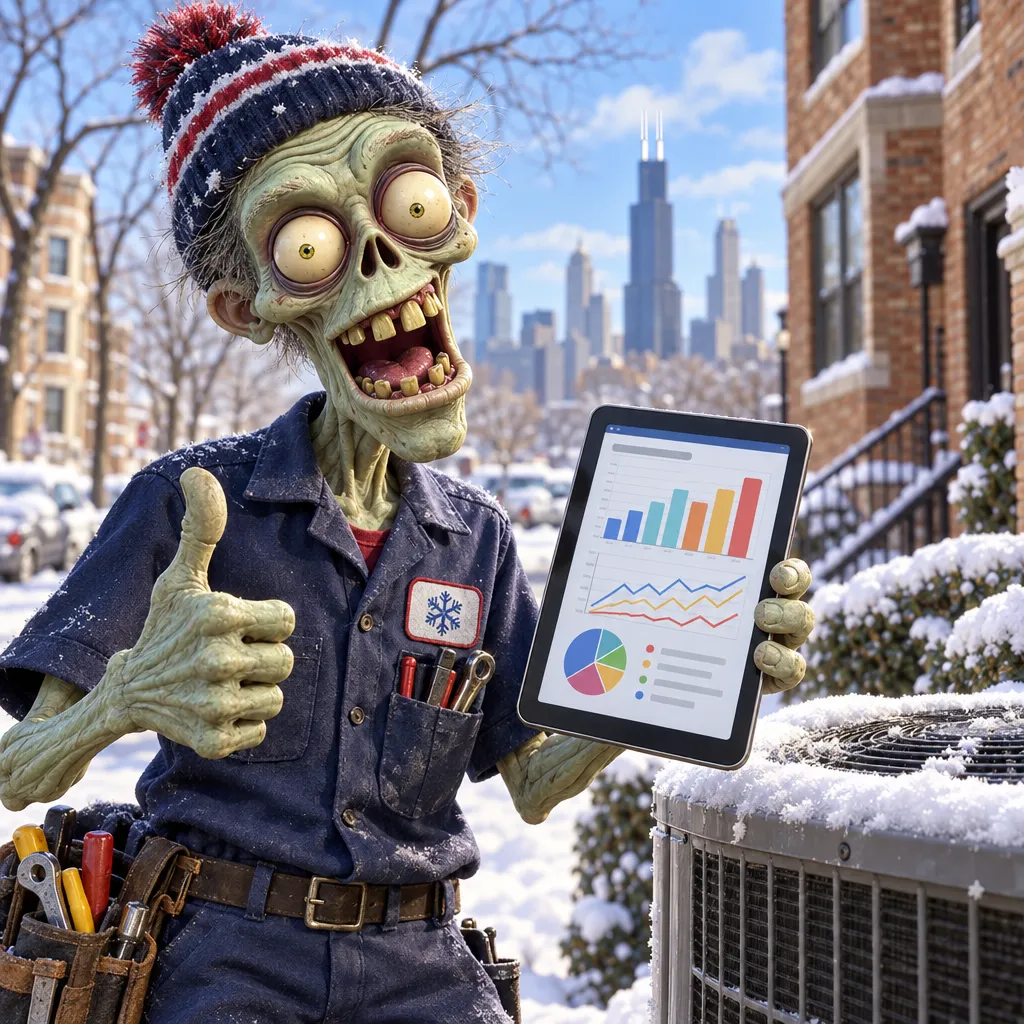
Four Seasons Walks Out of the Dark Ages
Their AI chats were lonely little islands. Two days on site started wiring them into a system that does the work.
The Challenge
Four Seasons Heating, Air Conditioning, Plumbing, Sewer & Electric is a nine-figure home service company serving Chicagoland and Northwest Indiana. Five divisions: HVAC sales, HVAC service, plumbing, electric and generators. One central marketing team handles marketing for all five.
This team wasn't behind on AI. They were already using ChatGPT and Claude. That was the problem. Every tool was its own island. Smart answers came out. Then they sat there until a human carried them somewhere by hand.
The Dark Ages
Ken calls it the dark ages of home service: smart people, smart tools, nothing connected. Here's what the week looked like:
- Reports stitched by hand: Export, copy, paste into a spreadsheet, repeat.
- The same mail piece, over and over: Direct mail meant 10 to 12 near-identical pieces every week. Swap a phone number, do it again.
- No single source of truth: Attribution was split across seven or more channels.
- Access that came and went: Connections kept getting switched off while IT worked out what was safe.
Their paid media lead put it best:
We all spend time inputting data, which is silly. It's very 2000s.
Day 1: Meet the Team That Never Sleeps
Early on Day 1, Ken demoed the autonomous AI marketing team he built. It now numbers 47 AI employees, and it's the engine behind Ad Zombies' aim to become the first billion-dollar creative agency in the world. They make ads and videos around the clock. Humans approve.
Then we built live, in the room:
- A live creative brief: The AI creative team turned Four Seasons' own ads and logos into a full ad set for print, social and short video. Its own review caught a disclaimer hidden behind app buttons. Feedback rounds added Chicago winter scenes and a bigger logo.
- A HubSpot automation plan, built by voice: An email and SMS automation spec, talked through out loud and split so two or three people can work on it at once.
The paid media lead had planned to hire someone for those automations. Then he watched the demo.
The more I think about this. I don't think we need a person.
Which raised the real question: what does this look like inside Four Seasons? The team sent their exports and reports so we could answer it by morning.
Overnight: The All-Nighter
While Chicago slept, we built:
- A version one reporting dashboard, built from their own spreadsheets.
- A banner pack engine. Type a title, a headline and an offer. It lays out every size. A human reviews.
- An HTML brand kit, including a competitor and reputation scan with sources cited.
- A starter kit for the whole team, built mostly by Tom Tran. More on that below.
Day 2: The Dashboard
The dashboard stole the morning. It's version one, running on sample exports, not live data yet. The paid media lead graded it anyway.
“For a 1.0, you know, Apple all-nighter, this is an A+.”
— Paid media lead, Four Seasons
What it tracks (shape only, no financials):
- Date filters: Defaults to the last complete week. A Monday to Sunday week view is coming.
- Filters that match the business: Tags, regions, service lines (HVAC sales, HVAC service, plumbing, electric, generators) and channels.
- The channels side by side: Paid search, paid social, direct mail, SEO and direct-to-website traffic, with affiliate phones and affiliate lead gen being added as their own channels.
- A drill-down tree: Marketing, channel, sub-channel, campaign or vendor, then phones vs. forms. It mirrors their tracking tags.
- Five tabs: Channels, campaigns, affiliate, service line and funnel.
- Swappable KPI tiles: Pick your numbers. Revenue stays locked in place. A bar chart splits by channel.
- Calls vs. forms: Inbound runs mostly on calls, so it shows calls vs. forms, call dispositions and contact percent.
- A KPI dictionary, coming next: The team already keeps one for each channel. The plan is to put it in the dashboard: click a metric, see its definition. Red and green flags against targets are on the list too.
- Built on their own data: Version one runs on exports from HubSpot, BigQuery (GA4 and Google Ads), CallRail call data and lead sources. Next: live data, plus per-person views through company sign-in.
That dictionary matters more than it sounds. When every channel defines a metric its own way, the meeting becomes an argument about math. One dictionary ends it.
Day 2: Wiring It In
The rest of the day was plumbing. Fitting, for a company that does plumbing.
- Connectors on: HubSpot was switched on and BigQuery was confirmed connected.
- Human in the loop: Email access is read-only. The AI can write drafts. It cannot hit send. A person does that.
- Images on the designer's machine: By late morning the designer's setup was already generating.
- A blind Halloween test: Shown that afternoon: a blind test run the Friday before. One piece of content, no training, five Halloween promo concepts, front and back. Lines like "Scary good deals," "Be the house with the lights still on" and "No tricks, just treats." Not perfect. First shots never are.
- Workspaces with manners: The designer's main promotion workspace got one rule up top: never overwrite anything without permission.
IT had been cautious from the start, and fair enough. Then they saw the plan to run scheduled jobs on always-on machines the company owns.
This is starting to make sense now. This is great.
They Own Everything
Plenty of vendors build you something and keep the keys. We do the opposite. The code goes in Four Seasons' own GitHub, the big files in their own storage, and the jobs will run on machines they own.
I don't want you guys to be dependent on us.
That was Ken. IT's answer to everything staying in-house: "Now that works. That works really well."
The Kit: Interviews, Skills and Wiring
The dashboard got the applause. The quiet build may matter more: a starter kit the team owns, built mostly by Tom Tran with Ken and Mason. We handed it over on Day 2, and a team member had the skills loaded into Claude that morning.
- Type "start": Claude asks who you are, shows your Day 1 notes to fix, and interviews you one question at a time on the Four Cs: Context, Connections, Capabilities, Cadence. Out comes a personal blueprint and a first build to start on.
- A leadership and IT interview: Built to settle where every skill's master copy lives and how updates reach everyone.
- History mining: Prompts that find skills hiding in work people already repeat.
On Day 2, at least one team member typed "start" and got a blueprint back. Suggested first build: automating the service line funnel report, their most frequent deliverable.
- Grill the plan (fs-grill-me): Grills the plan, one round of questions at a time, until nothing is assumed.
- Write the spec (fs-write-spec): Writes the plan up as a spec, with a definition of done and checks, before anyone builds.
- Build in checked steps (fs-build-from-spec): Builds one checked step at a time and stops for a human yes before anything is sent or written into a live system.
That's the house method, adapted for a marketing team from an open-source collection. Every skill carries a version number and a change log. A separate image skill runs on the team's existing ChatGPT subscription, no extra charge per image. By late morning on Day 2 the Mac version was making images. Windows was still being set up.
- One master copy: Shared knowledge, skills, plans, specs, a decision log and a build list in one place.
- House rules every AI tool reads: Two files made for the top of the shared Marketing folder: no invented offers, nothing sent or written to a live system without the owner's yes, no customer data, no keys.
- A glossary: Starts with "lead" and "call", words the team used more than one way. Each gets one definition.
- Ready-to-run build cards: Affiliate reporting, direct mail variations, and promotions to banner pack, with Day 1 facts preloaded. Plus an inbox watch that turns a page green, amber or red when a person is needed, and never replies or sends. All built and handed over, ready to run.
The payoff: nobody has to start from a blank chat. Knowledge lives in one place, not in seven people's heads. Every build follows one method, checks first, with guardrails written down for IT to review. A new hire can start by typing "start". It's the difference between handing someone a power drill and handing them a workshop with labeled shelves.
Key Shifts
That last one is Ken, talking to the designer:
My goal is to get you out of the worker bee slot, and put you in the queen bee slot.
AI produces. Humans approve. Nobody should spend another week resizing the same mailer.
What's Next
Two days was the test drive. Next, the team is working toward data flowing nightly into a database they own, the dashboard reading from it, scheduled jobs, and more AI skills for every role. Ken's goal: help Four Seasons move $1.2 million in outside overhead in-house with these new capabilities.
The Bottom Line
Four Seasons didn't need more AI. They needed the AI they had to stop living on islands.
In two days they got a working version one dashboard on sample exports, a banner pack engine ready to try, a brand kit, a starter kit of skills and interviews, and an IT team on board. Every piece belongs to them. Humans approve what goes out.
The $1.2 million is a target, not a trophy. We'll post results when they're real.
- Client
- Four Seasons Heating, Air Conditioning, Plumbing, Sewer & Electric
- Market
- Chicagoland and Northwest Indiana
- Divisions
- HVAC sales, HVAC service, plumbing, electric, generators
- Format
- Two days on site
- Delivered by
- Ken "Spanky" Moskowitz with Tom Tran and Mason
- Dashboard data
- Exports from HubSpot, BigQuery (GA4 and Google Ads), CallRail and lead sources
- Handed over
- 3 house skills, an image skill for Mac and Windows, 13 paste-ready prompts (including 3 pod build cards), house rules and a glossary
- Status
- Dashboard v1 on sample exports. Live data is next.