
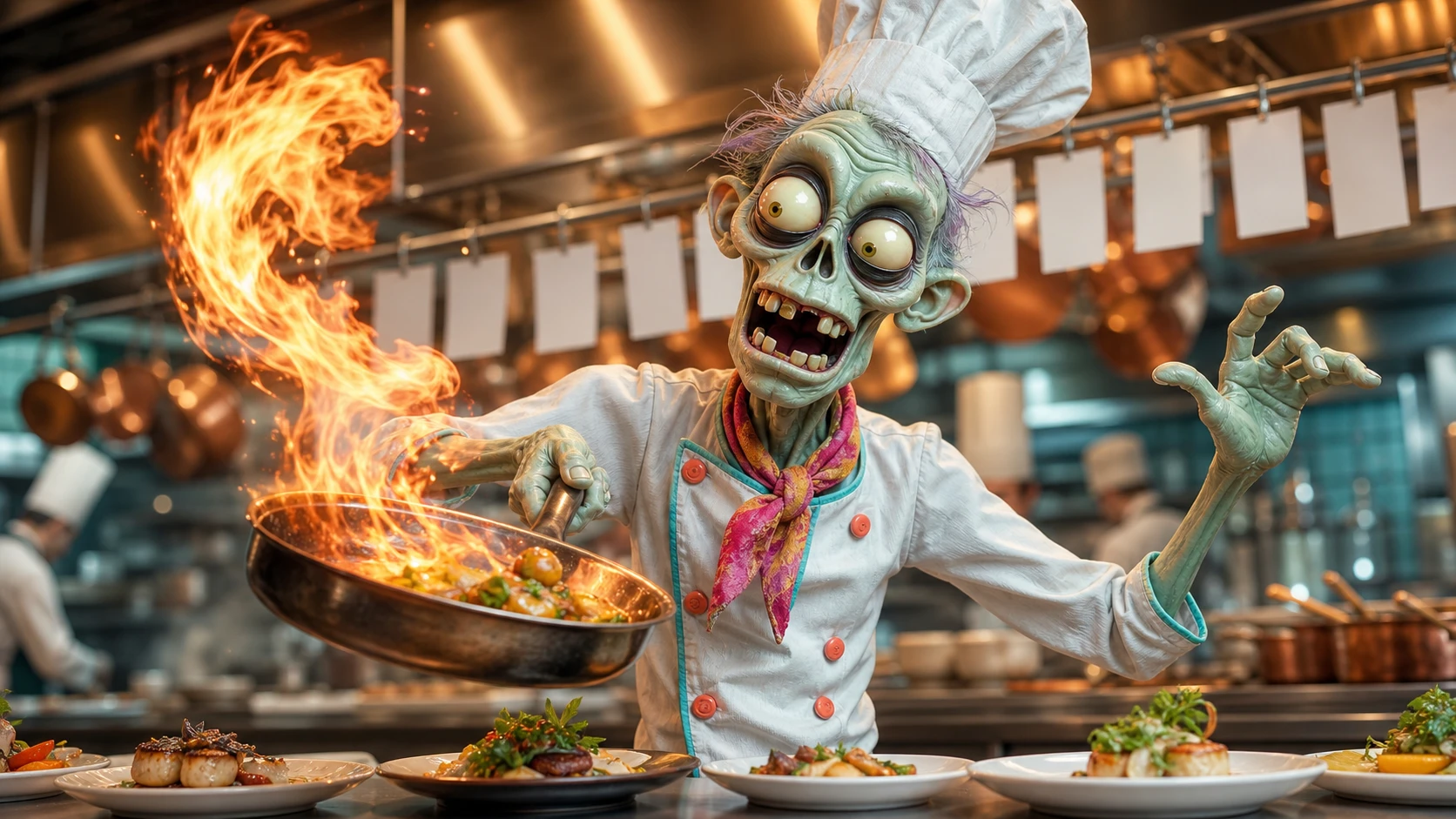
An Ad Zombies zombie chef flambeing a pan in a busy restaurant kitchen, plated dishes lined up on the pass
Restaurant Website Design

Your Guests Are Hungry Right Now. Your Website Should Be Built For That.

A hungry visitor decides in seconds — menu, hours, and a way to book a table. Most restaurant sites give them a slow-loading PDF menu and a phone number instead. Ours doesn't.

Ad Zombies builds websites specifically for independent restaurants — scoped around your actual menu, your actual dining room, and how your market actually eats out.

Ad Zombies is a branding, advertising, and marketing company founded by Ken “Spanky” Moskowitz — 40 years in advertising, 10 Super Bowl ads, $460 billion in client revenue generated across a career that includes Coca-Cola, the NFL, and Frito-Lay. Web Reanimation is our website rebuild service, built for a dining room that doesn’t have time to wait on a slow site.

What We Build For Restaurants

A menu that actually reads well on a phone, not a scanned PDF someone has to pinch-zoom to read
Reservation and waitlist flow built around how your dining room actually runs, not a generic booking widget
Photos and a home page built to convert a hungry visitor in the next ten minutes, not a brochure about your restaurant’s history
Online ordering and delivery-platform links in one place, not buried behind five different third-party buttons
Schema markup that helps Google — and AI search — surface your hours, menu, and location correctly
Full ownership: the code, the content, the domain, all of it, yours

How Much Does A Website Cost For A Restaurant?

That’s one of the first things every owner wants to know, and we’re not going to dodge it. Web Reanimation projects start at $10,000. Final investment depends on your menu, whether you want reservations and online ordering built in, and how much content we’re building. You get a fixed-price proposal after a free assessment — not a vague “it depends” and a follow-up call three weeks later.

What Happens After You Reach Out

1.Take the free Reanimation Assessment — 3 minutes, tells you exactly where your site is losing you business.
2.Get a fixed-price proposal scoped to your menu and how you take reservations and orders today.
3.We build: full audit, new architecture, all new copy, CMS setup, redirects, schema markup.
4.Launch, plus a 90-day check-in to make sure it’s actually performing.

Restaurant Website Design By Market

Every market has a different dining scene, labor landscape, and tourist mix. Pages built around specific markets:

Phoenix, AZ — Arizona's minimum wage climbed to $15.15/hr in 2026 and applies to tipped workers too (employers can only take a $3.00 tip credit down to a $12.15 cash floor), while metro Phoenix pulled in a record 47.7 million visitors and $13.4 billion in direct visitor spending in 2025 — a combination of rising front-of-house labor cost and high dining volume that rewards automating reservations, waitlist, and routine phone questions. Miami, FL — Florida's tipped cash wage is on a scheduled climb (to $11.98/hr by September 30, 2026, as the state minimum reaches $15.00) while its $3.02 tip credit stays frozen — meaning tipped-labor cost keeps rising every year regardless of tips — and Miami-Dade drew 28.3 million visitors generating $32.2 billion in economic impact in 2025, a volume of demand that makes reservation and review-response overhead a real operational load. Dallas–Fort Worth, TX — Texas has no state minimum wage above the $7.25 federal floor and allows the full federal tipped minimum of $2.13/hour, making front-of-house labor comparatively cheap to hire — but Dallas alone booked more than 1,400 events worth $1.56 billion in economic impact in FY2025, meaning the operational bottleneck for DFW restaurants is less about labor cost and more about handling a high, convention-driven volume of reservations and inquiries. Houston, TX — Houston runs on the same cheap, federally-set restaurant labor floor as the rest of Texas ($7.25/hr minimum, $2.13/hr tipped cash wage), but visitor volume hit a record 54 million in 2024 with restaurant and dining spend ranking among the largest visitor-spending categories — the demand-side pressure on reservations and reviews, not labor cost, is the distinguishing operational story here. Atlanta, GA — Georgia has no distinguishing tipped-wage law of its own — the federal $7.25 minimum and $2.13 tipped cash wage apply, and state law actually bars localities from setting a higher local minimum — but Atlanta sits behind the world's busiest airport by passenger count, a connectivity advantage that feeds a convention and layover-driven dining market on top of local demand. Los Angeles, CA — California is one of the small handful of states with zero tip credit — servers and hosts must be paid the full minimum wage (statewide $16.90/hr in 2026, with Los Angeles city's own local rate at $17.87/hr) before a single tip is counted — making front-of-house labor in LA some of the most expensive in the country, on top of a market so competitive that 52% of LA operators raised menu prices in just the past six months. Chicago, IL — Chicago is in the middle of phasing out its restaurant tip credit under a One Fair Wage ordinance — the city's minimum wage reached $17.05/hour in July 2026 with a $12.96/hour tipped floor, and while the City Council paused the phaseout at a $3.98 credit through mid-2028, the direction is toward full minimum wage for tipped staff — layered onto a convention calendar anchored by McCormick Place, which alone drew roughly 3 million visitors in 2025 including a 70,000+-attendee National Restaurant Association Show. Tampa, FL — Tampa Bay operates under the same rising Florida tipped-wage schedule as Miami (cash wage climbing to $11.98/hr by late 2026 on a frozen $3.02 tip credit), and food and beverage was the single largest category of the region's $9.4 billion in visitor-driven business sales — restaurants captured more tourist spending than lodging, entertainment, or retail. Orlando, FL — Orlando was the most-visited destination in the US in 2025 (a record 76.7 million visitors), while Florida's tip credit is frozen at $3.02/hr even as the state minimum wage keeps climbing toward $15 — meaning tipped cash wages rise every year regardless of tip income, pushing up the true cost of front-of-house staff in the country's busiest tourist market. Charlotte, NC — Charlotte's visitor economy set a record in fiscal 2025 — $1.2 billion in economic impact and 33 million visitors — even though North Carolina's minimum wage has been frozen at the federal floor of $7.25/hr (with a $2.13/hr tipped cash wage) since 2009, so the volume pressure on reservations and reviews is real even where the labor-cost pressure isn't. Las Vegas, NV — Nevada is one of the small number of states with no tip credit at all — restaurants must pay every tipped server, host, or bartender the full $12.00/hr minimum wage in cash on top of whatever they earn in tips — in a market that still pulled in 38.5 million visitors in 2025. San Antonio, TX — San Antonio's downtown alone supports more than 4,000 restaurants around a tourist core built on the Alamo (1.6 million visitors a year) and a convention business drawing 750,000+ delegates annually — a reservation and review-volume load that Texas's federal-floor labor costs ($7.25/hr, $2.13/hr tipped) don't offset with cheap staffing alone. Austin, TX — SXSW alone brought over 309,000 attendees to Austin in 2025 — with restaurants near the convention center reporting revenue roughly tripling during the festival — layered on an $11.1 billion annual tourism economy, a scale of seasonal reservation and waitlist spikes that Texas's federal-floor labor market ($7.25/hr, $2.13/hr tipped) isn't built to staff up for on short notice. Denver, CO — Denver's local minimum wage hit $19.29/hr in 2026 — with tipped food-and-beverage workers guaranteed $16.27/hr in cash before tips — one of the highest front-of-house wage floors of any US restaurant market, in a city that also pulled in a record 37.6 million visitors and $10.5 billion in tourism spending in 2025. Washington, DC — DC is mid-upheaval on tipped-wage law: voters passed Initiative 82 in 2022 to eliminate the tip credit entirely by 2027, the DC Council rolled that back in 2025 to a slower phase-in (tipped cash wage locked at $10/hr until July 2026, then climbing toward 75% of the full minimum by 2034) — layered onto a record $11.9 billion in 2025 visitor spending across 27.2 million visitors. Philadelphia, PA — Philadelphia is heading into a major tourism surge — more than 1 million visitors and $950 million in spending are projected across 22 citywide events in 2026 tied to America's 250th anniversary — while Pennsylvania's minimum wage has no distinguishing tipped-wage law of its own: it has sat at the federal floor of $7.25/hr (tipped cash wage $2.83/hr) since 2009, with no increase currently scheduled. Detroit, MI — Michigan's tipped minimum wage is on a fixed statutory escalator — 40% of the state minimum in 2026, climbing to 50% by 2031 — so Detroit restaurants face a front-of-house labor bill that is legally scheduled to keep rising for years, on top of a general minimum wage jumping to $15/hr in 2027. Seattle, WA — Seattle has zero tip credit — servers and hosts earn the full $21.30/hr city minimum wage (2026) before a single tip — while the metro's convention and hotel business is running at its busiest point in 14 years, meaning restaurants are paying the country's steepest guaranteed front-of-house wage during periods of peak reservation demand. Minneapolis, MN — Minneapolis sets its own local minimum wage of $16.37/hr in 2026 — nearly $5/hr above Minnesota's $11.41/hr state floor — and Minnesota bans tip credits statewide, so every host and server in the city earns that full local wage on top of tips, in a market with nearly 50% more restaurants per capita than the state average. San Diego, CA — San Diego's city minimum wage hit $17.75/hr in 2026 — with no tip credit anywhere in California — while the metro absorbed over 21 million visitors in just the first eight months of 2025, including a single week of Comic-Con that alone books more than 61,000 hotel room-nights and generates $160M+ in local economic impact. Riverside, CA — Riverside restaurants carry the same no-tip-credit, $16.90/hr statewide wage floor as coastal California markets — no local ordinance was found pushing the city rate higher — while the Inland Empire's own boutique convention center (70,000 sq ft of meeting space, opened 2014) is a small operation compared to the county-wide push now underway to expand tourism investment. Baltimore, MD — Maryland allows a deep tip credit — restaurants can pay servers as little as $3.63/hr in direct wages against a $15.00/hr minimum — so Baltimore's front-of-house labor cost is comparatively low, but the city's tourism engine (28.5 million visitors, $4.3 billion in spending in 2025) means that low-wage staff are absorbing an outsized volume of reservations, waitlists, and reviews relative to headcount. St. Louis, MO — Missouri state law preempts St. Louis from setting its own (higher) minimum wage — a city ordinance was rolled back after a brief run in 2017 — so restaurants staff at the flat state rate ($15.00/hr, tipped employees at 50%/$7.50/hr) even as St. Louis just posted a record tourism year, with $1.53 billion spent on food alone in FY2025. Sacramento, CA — Sacramento's own local minimum wage ordinance ($16.50/hr) is actually now below California's 2026 statewide minimum ($16.90/hr), so the higher state rate governs by law — with zero tip credit — even as the city just booked one of its strongest tourism years on record, generating $321.1 million in economic impact from 405 events in 2025. Portland, OR — Oregon bans the tip credit outright, so a Portland-metro server or host must be paid the full $16.80/hr minimum wage in cash before a single tip is counted — one of the highest guaranteed front-of-house wage floors in the country — while Portland also runs an unusually dense restaurant scene, at roughly one food-service establishment for every 118 residents. Nashville, TN — Nashville pulled a record-setting 17 million visitors in 2025 who spent an estimated $11.5 billion at hotels, restaurants and attractions, yet Tennessee has no state minimum wage law at all — restaurants can staff front-of-house on the bare federal $2.13/hr tipped cash wage, meaning the same crush of visitor demand has to be absorbed by a workforce that's cheap to hire but also cheap to lose to the next restaurant down the block. Raleigh, NC — North Carolina has no distinguishing tipped-wage law — the federal $7.25/hr minimum and $2.13/hr tipped cash wage apply statewide — while Raleigh/Wake County has built a genuine convention and sports-tourism engine, pulling in a record 19.1 million visitors in 2025 and $3.43 billion in visitor spending on top of its base of local diners. Columbus, OH — Ohio's 2026 minimum wage rises to $11/hr with a 50% tip credit allowing a $5.50/hr direct cash wage for tipped staff — a moderate, unremarkable labor cost by national standards — but Columbus runs one of the busiest convention centers in the Midwest, drawing over a million visitors a year through the Greater Columbus Convention Center alone, on top of statewide tourism that generated nearly $58 billion in 2025. Indianapolis, IN — Indiana has held its minimum wage at the bare federal floor of $7.25/hr (with a $2.13/hr tipped cash wage) since 2009 — among the cheapest legal labor costs in the country — while Indianapolis pulls in 30.5 million visitors a year spending $6.4 billion, with 745,000 square feet of connected convention space feeding a calendar of 65+ events and 1.8 million attendees in 2025 alone. Kansas City, MO — Missouri's minimum wage jumps to $15.00/hr in 2026 with only a 50% tip credit (a $7.50/hr cash floor for tipped staff) — and state law explicitly bars Kansas City from setting its own, higher local minimum — while the city itself draws roughly 29 million visitors a year and runs a 16-year-running, 10-day Restaurant Week that puts sustained volume pressure on the same tightly wage-regulated restaurant staff. Jacksonville, FL — Florida's minimum wage is on a legislated annual march to $15/hr by late 2026 (already $14.00/hr general, $10.98/hr tipped as of late 2025, rising again September 30, 2026), steadily raising front-of-house labor cost every year regardless of a restaurant's own decisions — while Jacksonville pulled over 8 million visitors in fiscal 2024 who spent $4.1 billion, with 'going out to eat' ranked the #1 thing those visitors did. Oklahoma City, OK — Oklahoma's minimum wage sits at the bare federal floor of $7.25/hr ($2.13/hr tipped) and voters explicitly rejected a 2026 ballot measure that would have raised it to $15 by 2029 — keeping front-of-house labor cheap by law — while Oklahoma City just posted a record 25 million visitors in 2025 who spent $775 million on dining alone, the single largest category of visitor spending in the city. Salt Lake City, UT — Utah has no state minimum wage above the federal floor, so Salt Lake City restaurants can legally pay tipped servers just $2.13/hour cash wage — among the cheapest front-of-house labor law in the country — while downtown alone logged 30.7 million visitor "customer days" and $2.1 billion in visitor spending in a single recent year. Cincinnati, OH — Ohio's state-set tipped minimum wage of $5.50/hour is more than double the federal tipped floor, making Cincinnati front-of-house labor structurally more expensive than in most states — while Hamilton County alone generated $4.4 billion in visitor spending, with visitors now accounting for a quarter of local business revenue. Cleveland, OH — Ohio's $5.50/hour tipped minimum wage (versus the $2.13 federal floor) makes staffing a Cleveland front-of-house meaningfully costlier than in neighboring federal-floor states, at the same time Cleveland is absorbing 300+ conventions and meetings a year bringing over 208,000 people downtown and supporting more than 20,000 food-and-beverage jobs. Pittsburgh, PA — Pennsylvania's restaurant labor law is genuinely unremarkable — a $7.25 minimum wage and $2.83 tipped cash wage close to the federal default — but Pittsburgh's restaurant industry leans hard on tourism anyway: Allegheny County visitor spending hit $6.8 billion in 2024 and was projected to reach roughly $7 billion in 2025. Milwaukee, WI — Wisconsin's tipped minimum wage sits just above the federal floor at $2.33/hour, so Milwaukee's baseline server labor cost is close to the national low end — but the city absorbs extreme seasonal demand spikes, including Summerfest, the self-described "World's Largest Music Festival," which drew 602,231 attendees in 2025 alone, an 8% year-over-year increase. Memphis, TN — Tennessee has no state minimum wage law at all — it runs entirely on the federal $7.25/$2.13 floor — making Memphis one of the cheapest legal labor markets for front-of-house restaurant staff in the country, even as Beale Street alone draws an estimated 5 million visitors a year and Graceland pulls in 500,000-plus annually. New Orleans, LA — Louisiana has no state minimum wage law — restaurant labor runs on the bare federal floor of $7.25/$2.13 — yet New Orleans absorbed 19.46 million visitors in 2025 who spent $10.8 billion, and the city ranked #3 nationally for hosting large-scale conventions, ahead of Chicago and Las Vegas. Richmond, VA — Virginia's minimum wage jumped to $12.77/hour in 2026 while the tipped cash wage stays at the $2.13 federal floor — meaning a Richmond restaurant owner is on the hook to cover a gap of up to $10.64/hour in tips before an employer subsidy kicks in, a far bigger employer exposure than in neighboring federal-floor states — and the Richmond region pulled in 19.1 million visitors in 2025, up 4.3% year over year.

Want AI chat and automated reservations built in? See AI integration for restaurants.

Frequently Asked Questions

Web Reanimation projects start at $10,000. Final investment depends on your menu, whether you want reservations and online ordering built in, and how much content we’re building. You get a fixed-price proposal after a free assessment — not a vague estimate and a follow-up call three weeks later.

You own everything. The code, the content, the domain, and access to your CMS. No monthly "hostage fees," no platform lock-in. If you want ongoing support after launch, that’s optional — Managed Hosting starts at $197/month — but it’s never required to keep your own site running.

Yes — we build reservation/waitlist flow and online-ordering links scoped around how your dining room actually runs, not a generic booking widget dropped on top.

Most Web Reanimation projects take 6 to 12 weeks from kickoff to launch. We accept a maximum of 5 Web Reanimation projects per month across every industry we work with, so timelines are real, not padded to make room for everyone who calls.

Ready to see what a real proposal looks like?

The assessment is free, takes three minutes, and won’t ask for a credit card.