
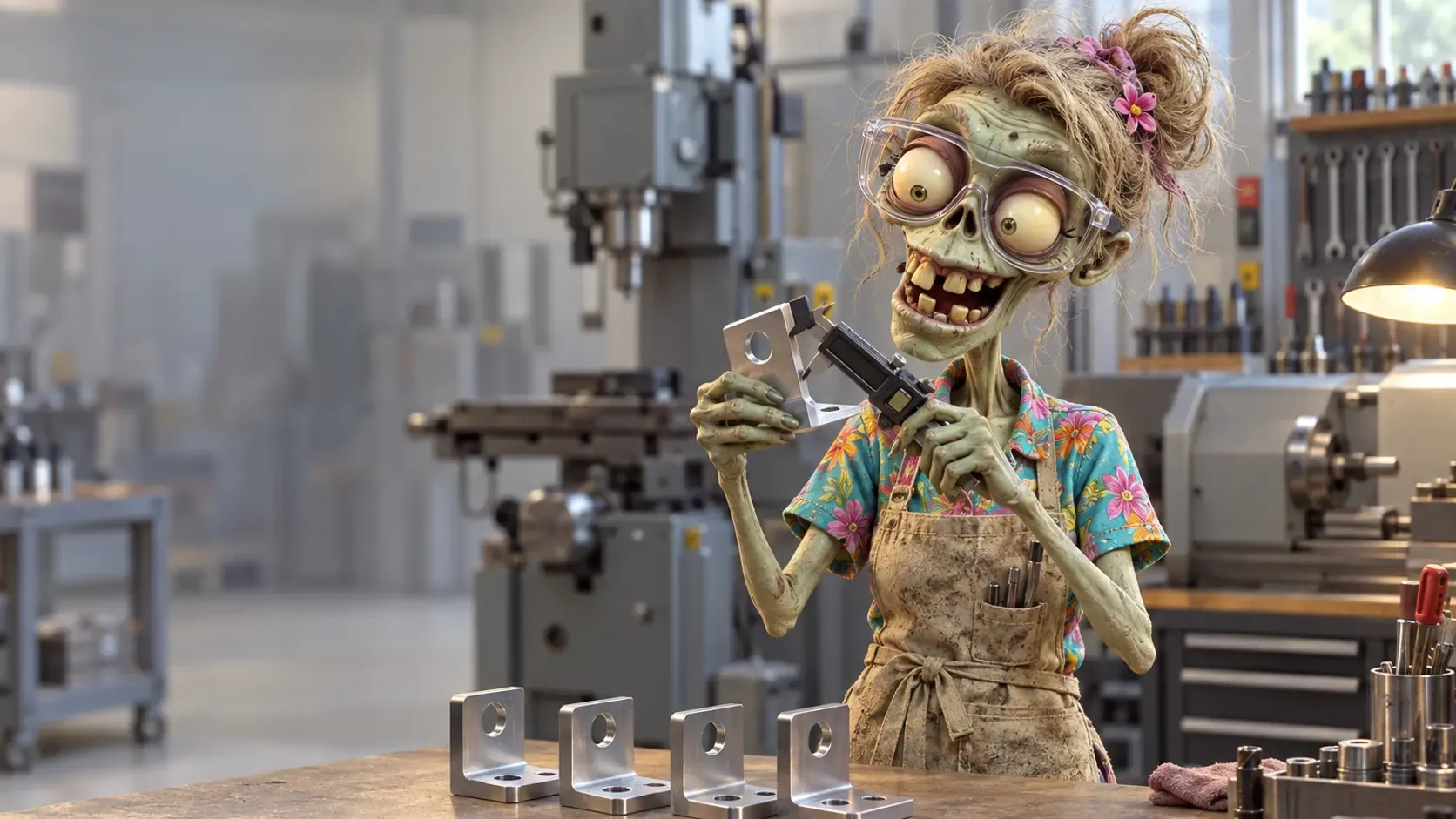
Manufacturing Website Design That Answers the Buyer Before the RFQ
A buyer may compare only a handful of suppliers. Your website is often where that comparison starts, so it has to answer the vetting questions on the first visit.
Ad Zombies builds websites for manufacturers and job shops. We start with the questions a buyer or an engineer asks before they call. Then we build the pages that answer them, in plain text.
Ad Zombies is a branding, advertising, and marketing company founded by Ken “Spanky” Moskowitz: 40 years in advertising, 10 Super Bowl ads, $460 billion in client revenue generated.
What does a manufacturer's website have to show?
It has to work as a vetting document. In a Thomas survey of 266 industrial buyers, reported in 2019, 71% said they will vet fewer than five suppliers before they decide. Engineers want part data, too. In a 2020 survey run by a CAD-content platform company, 92% of 2,563 designers and engineers said they would rather work with suppliers who provide CAD models.
So the site has to show what you make, which processes you run, which certifications you hold, and where an engineer can get part data. All of it in plain text. Every claim has to be one you can back up. Origin, certification and export claims each carry their own rules, covered below.
How buyers and engineers vet a supplier online
This is the step before the phone call. Several of our sources are old, or come from companies that sell into this market, so each one gets its sponsor and, where the source states it, its year.
Few suppliers make the shortlist
Thomas, an industrial sourcing and marketing platform, surveyed 266 industrial buyers in a report dated January 31, 2019. Of those buyers, 71% said they will vet fewer than five suppliers before they decide. 25% said five to ten, and 3% said more than ten.
Thomas runs a sourcing and marketing platform, so it has its own reasons to care about online discovery. Read the split as a direction, not a measurement.
Our reading: a buyer may compare you with only a few other shops. If the basic facts are missing, the buyer has to ask for them. A buyer with four other names on the list may not bother.
Your own website is a top research stop, and buyers are not satisfied with the information offered
An older procurement study from Acquity Group, reported by Cottrill Research, surveyed 500 procurement officers with annual purchasing budgets above $100,000. In it, 83% of respondents named supplier websites the most popular online research channel. The summary says buyers "are not satisfied with the level of information offered." The page does not print the study year, so we do not give one.
The quoted complaint is about the level of information offered. For a manufacturer, that could mean the capability list, the certifications and the part data. That is our reading. The study does not name those items.
Engineers want CAD models and data
TraceParts, a company that runs a CAD-content platform where manufacturers publish their parts catalogs, surveyed 2,563 designers and engineers in October and November 2020. 92% said they would rather work with suppliers who provide CAD models of their products. The survey came from a company with a commercial interest in CAD data, and the question wording is not on the page we read.
Our reading: a download page with missing or hard-to-find files can lose an engineer before purchasing ever sees the request. CAD and spec files are part of the buying decision, not extras.
Spec data has to be text a search engine can read
Google's guidance on AI search features says important content should be available in textual form. It also says structured data should match the text a visitor sees on the page. Google says no special markup is needed to appear in those features. That covers Google's own features only. It says nothing about other AI tools.
Our reading: capability lists, spec tables and certification lists should be real HTML text. An image of a spec sheet gives a crawler very little to read. We keep key facts as page text, not only in an image or a PDF. That is our own practice, not a Google rule.
What a first visit has to answer
These four come from our reading of the sources above. None is a finding in its own right.
What do you make, and how? The processes and the equipment, in plain text, on the first visit.
Are you certified, by whom, and for what scope? A certificate with no certifying body or scope gives a buyer nothing to check.
Can I get the part data without a sales call? Engineers want CAD and spec files.
How do I ask for a quote? The request path should be easy to find, and it should ask for the details a shop needs to quote the job.
The people side: recruiting pages
Recruiting pages count too. The US Bureau of Labor Statistics projects employment of machinists and tool and die makers to decline 1% from 2025 to 2035. BLS says machinists typically need a high school diploma or equivalent, and that machinists and tool and die makers typically gain competency through on-the-job training or an apprenticeship.
ASME's summary of a 2024 study by the Manufacturing Institute and Deloitte says U.S. manufacturing could see a gap of as many as 3.8 million jobs between 2024 and 2033. It says 1.9 million of those jobs could ultimately go unfilled. We read ASME's summary, not the primary study.
Our reading: a careers page that names the training path, such as an apprenticeship or on-the-job training, matches what BLS describes. A page that promises fast growth does not match the BLS projection. Name the job and the path. Skip the generic "join our team" line.
The rules that bite manufacturer websites
General information, not legal advice. This page covers no state law. It does not replace your own counsel. Ad Zombies does not review or approve claims, certifications or export files.
Most of the risk sits here. These rules cover what a page says, not how good your shop is. Each one is sourced to the regulation's text or the agency's own page. Where the sources do not settle a question, the copy says so and sends it to your counsel.
"Made in USA" needs all or virtually all US content
The FTC standard says a product can carry the label only when three things are true. Its final assembly or processing happens in the United States. All significant processing happens in the United States. All or virtually all of its ingredients or components are made and sourced in the United States.
This is a product-level test. Have your own counsel review any origin claim before it goes on a page. Ad Zombies does not review origin claims.
The FTC is active on this in 2026. On July 6, 2026, the agency sent warning letters to seven companies over Made in USA claims, and to one company over a Made in Texas claim. The agency said the products appeared to have been imported, in whole or in significant part. The release says the companies "appear to have misrepresented certain products" and that the letters "urge compliance" with the FTC's Made in USA standard. It does not report a finding of violation.
The release's own examples were drums, industrial laser machinery, coordinate measuring machines and e-cigarettes. Our practice, not a rule: look at every origin phrase on the site, including captions, footers, spec sheets and hashtags. Made in USA claims also show up on consumer product sites. If that is your business, see CPG website design.
Certifications need a certifying body and a scope
ISO's certification page says ISO does not perform certification or issue certificates. It also says the ISO logo cannot be used by anyone outside ISO unless explicitly authorized.
So an ISO 9001 claim is only as good as the certificate behind it. That certificate comes from an outside certifying body, and the site should name that body.
For AS9100, LRQA says an online resource lists organizations certified and registered under the IAQG rules, and that assessment reports are entered onto the IAQG OASIS database. A buyer may be able to look a certificate up there.
Our reading: the scope on the certificate should match the work you sell, and "precision manufacturing" in general is too vague for a buyer to check.
What we do: each certification gets its own entry. You give us the registrar, the certificate number and the scope. We publish what you give us. We do not verify or approve any certification, and you are responsible for its accuracy. We do not use a certification logo in place of those details.
ITAR registration does not confer export rights or privileges
This section covers only the registration rule named here. It says nothing else about export controls.
Under the State Department's rules, a US business that manufactures defense articles has to register with the Directorate of Defense Trade Controls (DDTC), even if it does not export. The rule says registration does not confer any export rights or privileges.
Two things follow for the copy. "ITAR registered" is the status the regulation describes, and it is accurate only for a company that is actually registered. "ITAR certified" is not the word 22 CFR 122.1 uses. We write "registered with DDTC." Have your export counsel review any ITAR line before it goes live. Ad Zombies does not review export wording.
Posting technical files is a question for your export counsel
A CAD file, a drawing or a spec sheet for a controlled part raises a question the sources we read do not settle: how publishing it on a website is treated under the export rules. This page does not state a rule on it.
Our reading: before a controlled-part file goes on a download page, your export counsel should look at it.
Safety, durability and warranty words
"Safe," "guaranteed" and "lifetime" are claims. Our practice, not a rule: treat every safety, durability and warranty word as a claim that needs documented terms behind it. We print the terms next to a "lifetime warranty." A "safe" machine needs a basis you can show. Your counsel decides what applies to your products.
Accessibility, and the wording we use
The DOJ's web guidance (March 18, 2022) says the Department "does not have a regulation setting out detailed standards" and relies on the ADA's general nondiscrimination and effective communication rules. It names WCAG and the Section 508 Standards as helpful guidance. It says it does not reflect the 2024 rule for state and local governments. The W3C published WCAG 2.2 as a Recommendation on December 12, 2024.
Section 508 applies to federal agencies. For contractors, its rules say that information technology a contractor acquires incidentally to a contract does not have to meet the Section 508 standards.
Two things can still reach you through a buyer. A 2024 DOJ rule adopts WCAG 2.1 AA for state and local governments. Whether a given buyer is covered is for that buyer or its counsel, and state law could change who counts. Some buyers write accessibility documentation into their contracts. That request comes from the contract, not from a law that covers your own site.
Our wording is "working toward WCAG 2.2 AA." That is a technical standard. It is not a legal conclusion and not a statement about legal compliance.
What we build for manufacturers
Each build is a Web Reanimation project. For a manufacturer, it covers the items below. Each ties to a source above.
- Capability and equipment pages written as HTML text, with no key fact left inside an image.
- A certifications page with the registrar, the certificate number and the scope for each standard you hold, supplied by you.
- Part and CAD download pages a buyer can open without a login.
- Controlled-part files are yours to call. You decide which files are controlled, and your own counsel does any export review. We do not classify or clear any file. We post nothing you have not told us is approved to post.
- An RFQ path with a short form that asks for the part details a shop needs to quote.
- A careers page that names the training path.
- A wording check before launch on origin, certification, warranty, safety and accessibility words. It is an editorial check by Ad Zombies that the wording matches what you supplied and what this page's sources say. It is not legal review, approval or clearance, and it does not verify that a claim is true. Your own counsel reviews your claims.
How much does a website cost for a manufacturer?
Web Reanimation projects start at $10,000. You get a fixed-price proposal after a free assessment.
Three things move the price: how many capability and product pages you need, how much part data and how many downloads go on the site, and how many certifications have to be documented with a registrar and scope.
What happens after you reach out
- Take the free Reanimation Assessment. It covers six areas: speed, SEO, AI readiness, conversion, mobile experience and technical health.
- Get a fixed-price proposal for the pages in scope, such as capability pages, certification entries and part downloads.
- We build the pages and run the wording check, an editorial check that is not legal review. Then we send the copy to you for sign-off before launch.
- Launch, then a 90-day check-in.
Questions this page answers
General information, not legal advice. This page covers no state law. It does not replace your own counsel. Ad Zombies does not review or approve claims, certifications or export files.
Start with what you make, the processes you run, and the certifications you hold, all in plain text. Add the part data an engineer needs, such as CAD files, and a clear way to request a quote. Buyers shortlist few suppliers, so the site has to answer these questions on the first visit.
Only if the claim is true under the FTC standard. The final assembly or processing, the significant processing, and all or virtually all of the components have to meet the US test. The FTC sent warning letters in July 2026 to companies that made these claims on products that appeared to be imported. Have your own counsel review the claim before it goes on a page. Ad Zombies does not review origin claims.
Name the certifying body, the certificate number and the scope. ISO does not issue certificates, and its logo cannot be used by anyone outside ISO unless explicitly authorized. LRQA says AS9100 certified organizations are listed in an online resource under the IAQG rules, so a buyer may be able to check one. The scope should match the work you sell. You supply these details and we publish them. We do not verify or approve any certification.
Engineers prefer suppliers who provide CAD models, according to a survey of 2,563 designers and engineers run by a CAD-content platform company. Before you post a file for a controlled part, have your export counsel look at it. The sources do not settle how publishing a file online is treated under the export rules, so this page does not state a rule on it.
The DOJ's web guidance says the Department "does not have a regulation setting out detailed standards." It relies on the ADA's general nondiscrimination and effective communication rules. Its 2024 rule for state and local governments is separate. A buyer's contract may still ask for accessibility documentation. This page covers no state law, and state law could change the answer. Our wording is "working toward WCAG 2.2 AA." That is a technical standard, not a legal conclusion and not a statement about legal compliance.
Most website projects take 6 to 12 weeks from kickoff to launch. Complex sites with large content libraries take longer.
Other industries we build for
- Construction Website Design
Buyers are told to check your license and insurance, and many rank references among their top hiring factors. Your site has to make all three easy to check.
- CPG Website Design
Shoppers often check a product online before they pick it up in a store. Your site has to say what it is, back up every claim, and show where to buy.
Sources
Sources last read October 14, 2026. Rules change; this page is not updated automatically. Some regulations were read in a university copy (Cornell Law). General information, not legal advice. This page covers no state law. It does not replace your own counsel. Ad Zombies does not review or approve claims, certifications or export files.
- Thomas, industrial buyer habits report, January 31, 2019. https://www.thomasnet.com/insights/new-thomas-report-reveals-industrial-buyer-habits/
- Procurement research summary (Acquity Group, via Cottrill Research). The page states no year. https://cottrillresearch.com/acquity-group-annual-study-reveals-b2b-online-research-habits-of-corporate-procurement-professionals/
- TraceParts survey of designers and engineers, run October and November 2020, summary published January 26, 2021. https://www.cimdata.com/en/industry-summary-articles/item/14931-2-563-designers-and-engineers-answered-the-traceparts-survey-aimed-at-understanding-their-expectations-of-industrial-parts-suppliers
- Google Search Central, AI features page (last updated December 10, 2025). https://developers.google.com/search/docs/appearance/ai-features
- US Bureau of Labor Statistics, machinists and tool and die makers (last updated August 27, 2026). https://www.bls.gov/ooh/production/machinists-and-tool-and-die-makers.htm
- ASME, summary of the manufacturing skills gap study, March 10, 2026. https://www.asme.org/topics-resources/content/manufacturing-faces-critical-gaps
- 16 CFR 323.2, Made in USA standard. https://www.ecfr.gov/current/title-16/chapter-I/subchapter-D/part-323/section-323.2Cornell Law copy: https://www.law.cornell.edu/cfr/text/16/323.2
- FTC press release on Made in USA warning letters, July 6, 2026. https://www.ftc.gov/news-events/news/press-releases/2026/07/ftc-warns-companies-making-questionable-made-usa-claims
- ISO, certification page. https://committee.iso.org/certification.html
- LRQA, AS9100 certification. https://www.lrqa.com/en-us/as9100/certification/
- 22 CFR 122.1, registration (Cornell Law copy of the regulation). https://www.law.cornell.edu/cfr/text/22/122.1
- US Department of Justice, web guidance for businesses, March 18, 2022. https://www.ada.gov/resources/web-guidance/
- US Department of Justice, fact sheet on the 2024 web accessibility rule for state and local governments. https://www.ada.gov/resources/2024-03-08-web-rule/
- W3C, Web Content Accessibility Guidelines 2.2. https://www.w3.org/TR/WCAG22/
- US Access Board, Section 508 and ICT standards. https://www.access-board.gov/ict/