
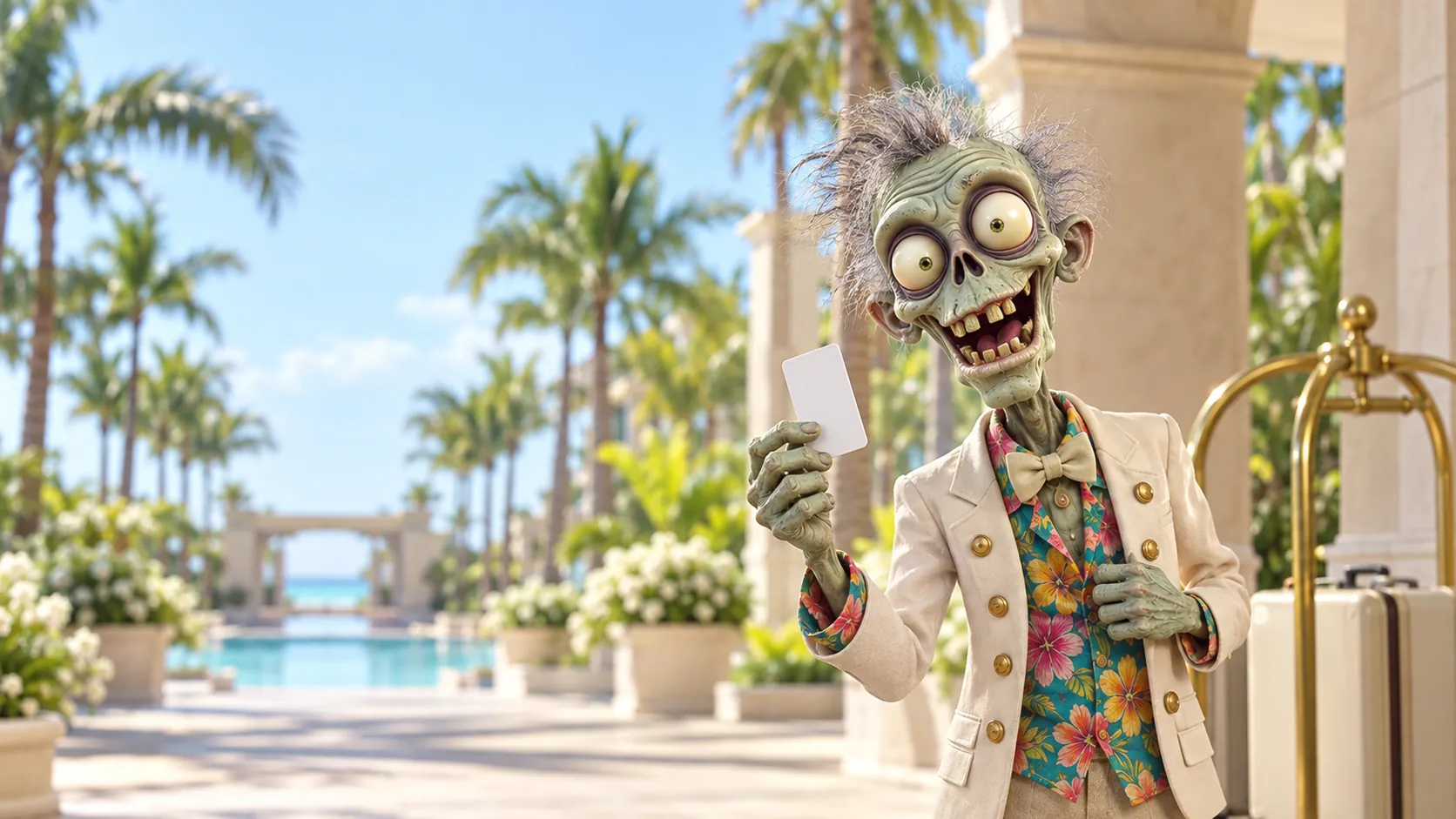
Hotel Website Design for Hotels and Resorts That Want Guests to Book Direct
Hotel website design for hotels and resorts: a clear booking path, a place to show the total price, and a place to describe accessible rooms. We scope every hotel and resort build in a conversation before we write a page.
A hotel or resort website has to do three things well. It has to take a guest from search to a booking. It has to show the total price, including the mandatory fees. And it has to describe accessible rooms in enough detail for a guest to judge them.
Booking direct matters because online travel agencies carry most independent hotel bookings. Cloudbeds, a hotel software company, puts that share at 63.4% in its 2026 report.
Hotel and resort builds take 6 to 12 months, depending on scope and scale. Our usual website build takes 6 to 12 weeks. Hotel work runs longer. The timing section below lists what we expect drives that. Every hotel and resort build is custom, and we start with a conversation.
The sources are listed at the bottom. This is general information, not legal advice. Which rules apply to your hotel is a question for your counsel.
What does a hotel or resort website have to do?
A hotel or resort website has to take a guest from search to a booking, with the total price shown and accessible rooms described.
Start with the booking path. A guest who finds you in search wants to see rooms, a price and a way to book. If any one is wrong or missing, the guest has no reason to stay.
Two rules sit on top of that path. One is the total price. The other is how you describe accessible rooms. The rules section below covers both.
How hotel and resort owners choose a web vendor
We did not find research on how hotel buyers pick a web vendor. We found rules, one set of market data, and one platform's own guidance. Read what follows as those sources, not as a survey of hotel buyers.
Who controls the site comes first
Ask who controls the site before anyone quotes one. An independent hotel may decide its own site. A brand-flagged hotel may be bound by its franchise rules to buy certain systems through the brand.
The federal franchise disclosure rule covers those duties. Its text does not name websites or booking software. Each brand sets its own rules in its own documents. We have not read those documents, so we make no claim about any brand.
Our reading: we ask the owner, and the brand contract if there is one, before we scope a site.
Online travel agencies are why a direct site matters
Cloudbeds reports that online travel agencies, or OTAs, took 63.4% of independent hotel bookings. Its data covers 2025 bookings in 180 countries.
Cancellations tell the same story. Cloudbeds reports a 21.8% cancellation rate on OTA bookings. It says that is more than double the 10.6% rate on direct bookings.
Cloudbeds sells hotel software. Treat these as its numbers. We do not state a target share for direct bookings. Each hotel sets its own goal.
Loyalty members are a direct channel
Loyalty members booked 58% of U.S. hotel room nights in the first half of 2026. That is up from 51% in 2019, according to Kalibri data, published in Lodging Magazine in an article by a Kalibri executive. It is not independent reporting.
That counts room nights, not direct bookings.
Our reading: a member sign-in and a clear booking path for members are direct channels a site can build. How many members book direct is a question the hotel's own data answers.
The booking connection is a site problem and a vendor problem
Google says its free hotel booking links are ordered by several factors, including landing page experience and the historical accuracy of the prices provided to Google.
Our reading: a guest who clicks through from search should land on a page that shows the same price the booking system will charge.
A hotel that uses a reservation system may already be connected to Google through its provider. Google tells hotels to check with that provider.
We connect a site to a hotel's booking system only where the hotel's own vendor confirms the connection. We do not promise a connection to any booking engine or property system.
Group and events buyers look for specifics
Our reading: a planner looks for facts before adjectives. Capacity charts, floor plans, room measurements, photos of real events, and a named sales contact answer most first questions. We would build each one as plain text and images on its own page. The hotel supplies every fact.
The rules that bite hotel websites
Several rules reach a hotel website. Some are federal, some come from the FTC, and some depend on the state. We read most of them in the rule text or the regulator's own pages. The California item rests on the state Attorney General's FAQ, not the statute text, and it says so. This is not every rule that may apply to your hotel.
General information as of October 2026, not legal advice. Ad Zombies is a marketing agency and does not give legal advice. Ask your own counsel which rules apply to your hotel or resort.
Total price: the FTC rule covers hotels
The FTC's junk fees rule took effect May 12, 2025. The FTC's own FAQ lists temporary sleeping accommodations at a hotel, motel or inn as covered, and names no hotel exemption.
If an ad or offer shows a price, it has to show the total price a guest will pay, upfront and prominently. The FTC's example: a required resort fee must be included in the total price.
The FTC's FAQ says it reflects staff views and is not binding on the Commission. Read it as guidance, not as a final ruling.
California has a similar rule for hotels. The California Attorney General's FAQ says a state law in effect since July 1, 2024 bars advertising a price that leaves out mandatory fees, and it lists hotels among the businesses covered. We read the Attorney General's FAQ, not the state law itself.
This page shows no hotel prices. A hotel sets and shows its own prices.
Accessible rooms: describe them in enough detail
Federal rules for hotel reservations reach more than the front desk. The rule at 28 CFR 36.302(e) applies to hotels and resorts that own, lease or operate lodging. Its reservation duties cover bookings made by phone, in person, or through a third party.
Hotels must identify and describe accessible room features in enough detail for a guest with a disability to judge them on their own.
The site we build can carry that description. The hotel writes the content and owns it. We do not certify that a hotel's site meets any accessibility standard or law. On adzombies.com, we say we are working toward WCAG 2.2 AA, and nothing stronger. Working toward a standard is not a legal clearance. It does not make a hotel compliant with any law.
Guest reviews and quotes
The FTC's reviews rule bans fake reviews, including AI-generated ones. It also bars a business from misstating that the reviews on its website represent all or most of the reviews submitted. The FTC announced the final rule on August 14, 2024.
A guest quote is an endorsement. It must reflect the guest's honest opinion. A connection the audience would not expect, such as a paid testimonial or a staff member, must be disclosed clearly and conspicuously.
This page carries no guest quotes.
What we build for hotels and resorts
We would scope these items for a hotel or resort build. Each one says what stays with the hotel.
- A total-price display. We build the place on the site where the total price shows, with mandatory fees in the total. The hotel supplies the rates and fees, and the hotel owns them.
- Accessible-room descriptions. A place to describe each accessible room in the detail the hotel supplies. The hotel owns the content. We do not certify that the hotel's site meets any accessibility standard or law. On adzombies.com, we say we are working toward WCAG 2.2 AA.
- A booking path that works with the hotel's own system. We connect it only where the hotel's vendor confirms the connection. We do not promise a link to any booking engine or property system.
- Group and events pages. Capacity charts, floor plans, room measurements, event photos and a named sales contact, laid out so a planner can find each one. The hotel supplies the facts.
- A reviews block, if the hotel wants one. It shows real reviews. It never says it shows all of them unless it does.
The build runs under our Web Reanimation service. That page lists a starting price for standard websites. Hotel and resort builds are custom and have no starting price.
How long does a hotel or resort website take?
Hotel and resort builds take 6 to 12 months, depending on scope and scale. That is an exception to our usual website timeline of 6 to 12 weeks.
A hotel build runs longer than our usual website build. We would expect these to drive the length:
- The number of properties.
- The booking system connection, and the time the hotel's own vendor needs to confirm it.
- Group and events pages.
- The photo and media volume.
- Who controls the site, and any brand contract that sets its rules.
Scope and scale decide the length.
How much does a hotel or resort website cost?
Every hotel and resort build is custom, so there is no starting price. The cost depends on scope and scale.
The same things that drive the length drive the scope: the number of properties, the booking system connection, and the group and events pages.
To find the cost, book a call. After we talk, you get a proposal based on scope.
What happens after you reach out
Here is how a hotel or resort project runs.
- Book a call. You talk with us about your hotel or resort, what you want the site to do, and who decides.
- Keep talking through scope. We ask who controls the site, how many properties you run, and what booking system you use. The hotel's own vendor confirms any booking connection before we build one.
- Get a proposal based on scope. It comes out of those conversations.
- We build. A full audit, a new site structure, all new copy, CMS setup, redirects and schema markup.
- Launch. The build takes 6 to 12 months, depending on scope and scale.
Questions hotel teams ask
A hotel or resort build takes 6 to 12 months, depending on scope and scale. Our usual website build takes 6 to 12 weeks. The drivers we would expect are listed above.
Every hotel and resort build is custom, so there is no starting price. The cost depends on scope and scale. To find it, book a call. After we talk, you get a proposal based on scope.
Under the FTC's junk fees rule, a required resort fee has to be in the total price. The FTC's FAQ lists hotels as covered and names no hotel exemption. The FAQ says it reflects staff views and is not binding on the Commission. California has a similar rule, according to the California Attorney General's FAQ. Your hotel and its counsel decide how your prices are shown. We do not set your rates or fees. Ask your own counsel which rules apply to you.
Federal rules for hotel reservations require accessible room features to be described in enough detail for a guest to judge them. Those duties cover phone, in-person and third-party bookings. We build a place for that description. The hotel writes it and owns it. We do not certify that the hotel's site meets any accessibility standard or law. On adzombies.com, we say we are working toward WCAG 2.2 AA. That is not a legal clearance. Ask your own counsel which rules apply to you.
Reviews have to be real. The FTC bans fake reviews, including AI-generated ones. A site may not claim its reviews are all or most of the reviews when they are not. A guest quote is an endorsement, so it must reflect the guest's honest opinion. Any paid or staff connection must be disclosed clearly. This page carries no guest quotes.
Only where your booking vendor confirms the connection. We do not promise a connection to any booking engine or property system.
Ad Zombies is a branding, advertising, and marketing company founded by Ken “Spanky” Moskowitz: 40 years in advertising, 10 Super Bowl ads, $460 billion in client revenue generated.
Other industries we build for
- Restaurant Website Design
A hungry guest decides in seconds. The menu, the hours, and the table booking have to work on the first try.
- Hospital Website Design
Patients come looking for a doctor and a service. Your site has to make each one easy to find, with accessibility and price posting rules in mind. Every hospital build is custom, planned in a conversation.
Sources
Rules and sources last checked October 2026. General information, not legal advice.
- Cloudbeds, 2026 State of Independent Hotels report, as published by HospitalityNet. https://hospitalitynet.org/news/4131619/cloudbeds-2026-state-of-independent-hotels-report-reveals-tightening-margins-shifting-traveler-behavior-and-rising-ota-dominance.html
- Kalibri national booking data, in a Lodging Magazine article by a Kalibri executive, September 17, 2026. https://lodgingmagazine.com/dont-discount-loyalty-bookings-from-program-members-are-the-fastest-growing-channel/
- Google, hotel prices help page. https://support.google.com/hotelprices/answer/10472393
- FTC, Rule on Unfair or Deceptive Fees: Frequently Asked Questions (FAQ dated May 2025). https://www.ftc.gov/business-guidance/resources/rule-unfair-or-deceptive-fees-frequently-asked-questions
- California Attorney General, SB 478 Frequently Asked Questions. https://oag.ca.gov/system/files/attachments/press-docs/SB%20478%20FAQ%20%28B%29.pdf
- 28 CFR 36.302, reservations, text as shown by Cornell Law School LII. https://www.law.cornell.edu/cfr/text/28/36.302
- 16 CFR 436.5, franchise disclosure, text as shown by Cornell Law School LII. https://www.law.cornell.edu/cfr/text/16/436.5
- FTC press release on the final rule banning fake reviews and testimonials, August 14, 2024. https://www.ftc.gov/news-events/news/press-releases/2024/08/federal-trade-commission-announces-final-rule-banning-fake-reviews-testimonials
- FTC, Endorsement Guides: What People Are Asking. https://www.ftc.gov/business-guidance/resources/ftcs-endorsement-guides-what-people-are-asking