
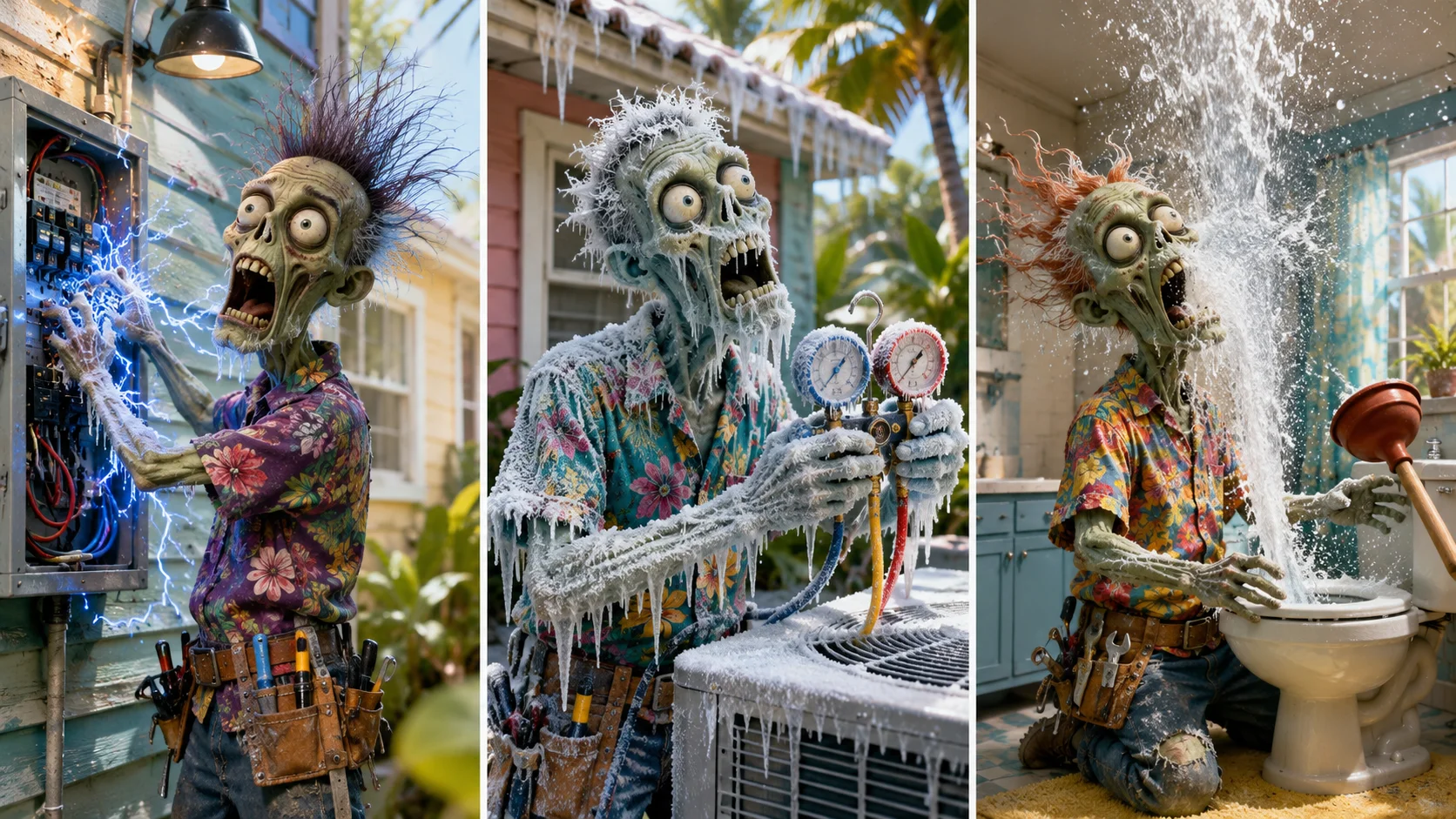
Three Ad Zombies zombie tradesmen having a very bad day — an electrician getting shocked at an open breaker panel, an air conditioning tech frozen solid in icicles at a condenser unit, and a plumber taking a geyser of water in the face from a toilet
Plumbing Website Design

A Burst Pipe Doesn’t Wait For Your Website To Load.

When someone’s basement is flooding at 2am, they’re not calmly comparing five plumbers. They’re searching, panicking, and clicking whoever loads first and looks like they’ll actually show up. If that site is slow, that customer just became your competitor’s.

Ad Zombies builds websites specifically for plumbing companies — built to survive the exact moment they matter most: a middle-of-the-night emergency when the customer just needs someone to answer.

Ad Zombies is a branding, advertising, and marketing company founded by Ken “Spanky” Moskowitz — 40 years in advertising, 10 Super Bowl ads, $460 billion in client revenue generated across a career that includes Coca-Cola, the NFL, and Frito-Lay. Web Reanimation is our website rebuild service, built for businesses that live and die by whether the phone rings today, not next quarter.

What We Build For Plumbing Companies

Separate content for leak detection, repipe, and water treatment — not one page that only covers whichever service is easiest to write about
Load times fast enough to hold up when a burst pipe sends a whole neighborhood searching at once
Emergency and same-day service made obvious above the fold, not buried under a paragraph of company history
Content built around your area’s actual water hardness, supply-pipe era, and foundation type, not a generic "we fix pipes" page
Schema markup that helps Google — and AI search — surface you for repair intent and installation intent, not just whichever one you happened to write more about
Full ownership: the code, the content, the domain, all of it, yours

Most contractor websites are built by agencies that use the same site for every trade and just swap the logo. We build from your actual brand, your actual systems and brands you install, and your actual service area.

How Much Does A Website Cost For A Plumbing Company?

That’s one of the first things every owner wants to know, and we’re not going to dodge it. Web Reanimation projects start at $10,000. Final investment depends on how many service areas and pages you need, how much content we’re building, and whether you want an integrated quote-request tool or AI chat. You get a fixed-price proposal after a free assessment — not a vague “it depends” and a follow-up call three weeks later.

How Long Does It Take?

Most Web Reanimation projects take 6 to 12 weeks from kickoff to launch. We accept a maximum of 5 Web Reanimation projects per month across every industry we work with — so timelines are real, not padded to make room for everyone who calls.

What Happens After You Reach Out

1.Take the free Reanimation Assessment — 3 minutes, tells you exactly where your site is losing you business.
2.Get a fixed-price proposal scoped to your trade and service area.
3.We build: full audit, new architecture, all new copy, CMS setup, redirects, schema markup.
4.Launch, plus a 90-day check-in to make sure it’s actually performing.

Plumbing Website Design By Market

Plumbing demand isn’t the same business everywhere — water hardness, supply-pipe era, and freeze risk change what actually sells. Pages built around specific markets:

Phoenix, AZ — Two compounding local forces: some of the hardest water in the country, and slab foundations sitting on expansive clay that keeps stressing the pipe underneath them. Miami, FL — Aging cast iron sewer lines sitting in porous limestone under a very high water table -- a combination that makes the failure mode, the repair method, and the price tag all locally specific. Dallas–Fort Worth, TX — The ground itself is the adversary here -- clay that swells up to 30% when wet and shrinks in drought, dragging every pipe under the slab along with it. Houston, TX — Sewer backups are far more common here than in higher-elevation cities, because groundwater forces its way into the sewer system from outside. Atlanta, GA — Atlanta is the mirror image of a hard-water market: the supply is soft and acidic, and it eats pipe from the inside while red clay stresses it from the outside. Los Angeles, CA — LA has no single water chemistry -- hardness changes depending on which of three supplies is feeding your block, which makes blanket advice actively wrong here. Chicago, IL — Chicago has more lead service lines than any city in the country, and a legally mandated multi-decade replacement program. This is the largest single plumbing demand story in America. Tampa, FL — Tampa Bay has a documented, region-wide cast iron failure problem -- an entire generation of sewer laterals hitting end of life at the same time. Orlando, FL — Central Florida is built on dissolving limestone, which means an Orlando plumbing leak can be a symptom of the ground moving rather than the pipe failing. Charlotte, NC — Charlotte's crawl spaces hide leaks that a slab market would catch in a week -- which is why the damage bill here is so often bigger than the repair. Las Vegas, NV — Las Vegas has some of the hardest water in the United States -- harder than Phoenix -- and it comes almost entirely from one source. San Antonio, TX — San Antonio's water comes out of limestone and its houses sit on clay that moves with the drought. Both problems have the same address and neither is optional. Austin, TX — Austin has very hard water and a formal, numbered drought ladder -- so both the scale problem and the irrigation problem come with published thresholds. Denver, CO — Denver's expansive bentonite clay soil moves with every wet/dry cycle, and it's the region's older cast-iron and polybutylene pipe that pays the price. Washington, DC — DC's water is moderately hard, its rowhouse-heavy building stock still has tens of thousands of lead or galvanized service lines in the ground, and the city's century-old combined sewer system makes root intrusion and overflow issues a live local concern. Philadelphia, PA — Philadelphia's plumbing market is shaped by a huge inventory of pre-1950s rowhomes with original cast-iron/clay sewer laterals and stone foundations, plus a city-run push to eliminate an estimated 20,000 lead service lines within a decade. Detroit, MI — Detroit combines three separate plumbing stress points most metros only have one of: a deep frost line that bursts pipes and mains, a citywide backlog of lead and galvanized service lines being actively replaced, and aging clay sewer laterals prone to root intrusion. Seattle, WA — Seattle's exceptionally soft Cascade-sourced water spares pipes from scale buildup, but the city's older housing stock still carries original clay and cast-iron sewer laterals now failing to root intrusion, while occasional hard winter cold snaps catch underinsulated crawlspace plumbing off guard. Minneapolis, MN — Minneapolis pairs a deep-frost climate (footings required 42-60 inches down) with an old, largely basement-foundation housing stock — a combination that drives both burst-pipe emergencies and aging supply/sewer material replacements. San Diego, CA — San Diego's water is classified 'very hard' by USGS standards, and decades of pre-PEX-era construction plus a foundation mix of slab and crawlspace mean scale buildup and aging supply lines are common local issues — with essentially zero freeze-burst risk. Riverside, CA — Riverside's water is very hard (roughly 212 ppm) and a big slice of the housing stock was built right in the era when polybutylene piping was standard — a bad combination for scale buildup and pipe failure. Baltimore, MD — Baltimore's water is moderately hard and its housing stock is old enough that lead and galvanized service lines are still common enough that the city is actively mailing residents notification letters about pipe material as of 2025. St. Louis, MO — Old clay sewer laterals nearing the end of their design life, hard water across most of the metro, and a housing stock split between basements and slab/crawlspace construction on shrink-swell clay soil. Sacramento, CA — Sacramento water arrives extremely hard off Central Valley mineral-rich runoff, and the city's older neighborhoods still run on original clay sewer laterals that crack under the region's dramatic dry-summer/wet-winter soil swings. Portland, OR — Portland's housing stock spans three distinct plumbing-material eras -- pre-1970s galvanized, a 1978-1995 polybutylene window, and modern PEX/copper -- combined with soft municipal water and clay sewer laterals nearly universally prone to root intrusion. Nashville, TN — Nashville's municipal water, drawn from the Cumberland River and run through limestone-rich Middle Tennessee geology, comes in moderately hard — while winter still delivers enough sub-freezing nights to put exposed pipes at real risk. Raleigh, NC — Raleigh's municipal water, drawn from Falls Lake and Lake Benson, is unusually soft — the opposite problem from most Southeastern metros — which shifts the local plumbing conversation toward supply-pipe mix and winter freeze exposure. Columbus, OH — Columbus's own utility rates its water 'moderately hard,' and the city's code-mandated 32-inch frost-line depth for footings confirms a real winter freeze zone. Indianapolis, IN — Indianapolis pairs real winter freeze risk with hard water and an older housing stock — a combination that shows up as both burst-pipe calls and water-heater/fixture scale. Kansas City, MO — Kansas City's tap water is drawn straight from the Missouri River and actively softened at the treatment plant citywide, while the city's genuinely cold winters create real annual freeze/burst risk on top of an old housing stock. Jacksonville, FL — JEA's municipal water, drawn from the Floridan aquifer, runs Hard to Very Hard across most Jacksonville zip codes. Oklahoma City, OK — OKC's tap water runs hard enough to scale water heaters over time, and many older neighborhoods still carry pre-1960s clay sewer pipe that's now well past its expected service life. Salt Lake City, UT — Salt Lake City's tap water is medium-to-very hard, and its older core neighborhoods still carry pre-1950s clay sewer laterals well past their design life. Cincinnati, OH — Cincinnati pairs real winter freeze risk with moderately hard water and an aging, consent-decree-monitored sewer system. Cleveland, OH — Cleveland plumbing work is defined by a deep frost line that makes basements the regional default over slabs, moderately hard Lake Erie-sourced water, and a housing stock old enough that supply-pipe material varies widely by build era. Pittsburgh, PA — Old housing stock, aging municipal sewer infrastructure, and moderately hard water combine into a distinctive Pittsburgh plumbing market — ALCOSAN is mid-way through a legally mandated multi-billion-dollar overflow-reduction program. Milwaukee, WI — Milwaukee sits on old lead infrastructure and genuinely hard Lake Michigan-sourced water, with a state building code that requires footings to clear a deep frost line every winter. Memphis, TN — Memphis draws uniquely soft, naturally filtered water straight from the Memphis Sand Aquifer -- but the city's real plumbing headline this decade has been recurring hard-freeze events bursting pipes and water mains. New Orleans, LA — New Orleans sits on soft, marsh-derived soil with a high water table below sea level in a bowl ringed by levees, so raised pier-and-beam foundations are common instead of basements. Richmond, VA — Richmond is one of the older water systems on the East Coast and is actively working, block by block, to find and replace lead and galvanized service lines in its oldest neighborhoods.

Work in a different trade? See website design for home service businesses for air conditioning, electrical, and garage door.

Frequently Asked Questions

Web Reanimation projects start at $10,000. Final investment depends on how many service pages and service areas you need, how much content we’re building, and whether you want an integrated quote-request tool or AI chat. You get a fixed-price proposal after a free assessment — not a vague estimate and a follow-up call three weeks later.

That’s exactly what it’s built for. Emergency plumbing searches happen at the worst possible hours, and most contractor sites are slow, bloated, and buried under company history before they get to the phone number. Web Reanimation sites load in under a second and put emergency service where a panicked visitor can actually find it.

You own everything. The code, the content, the domain, and access to your CMS. No monthly "hostage fees," no platform lock-in. If you want ongoing support after launch, that’s optional — Managed Hosting starts at $197/month — but it’s never required to keep your own site running.

Yes — that’s exactly what a Web Reanimation build for a plumbing company usually includes. If you install and repair across six cities, you need pages that actually target each one, not a single "service areas" page with a list of towns at the bottom.

Platforms like ServiceTitan or Housecall Pro bundle a basic site with their software, but you’re usually renting a template, not owning a real website — and it’s built to be good enough, not to actually rank or convert. Web Reanimation is a from-scratch build on its own stack, made to perform, that you keep even if you switch field service software later.

Ready for the next burst-pipe emergency?

The assessment is free, takes three minutes, and won’t ask for a credit card.