
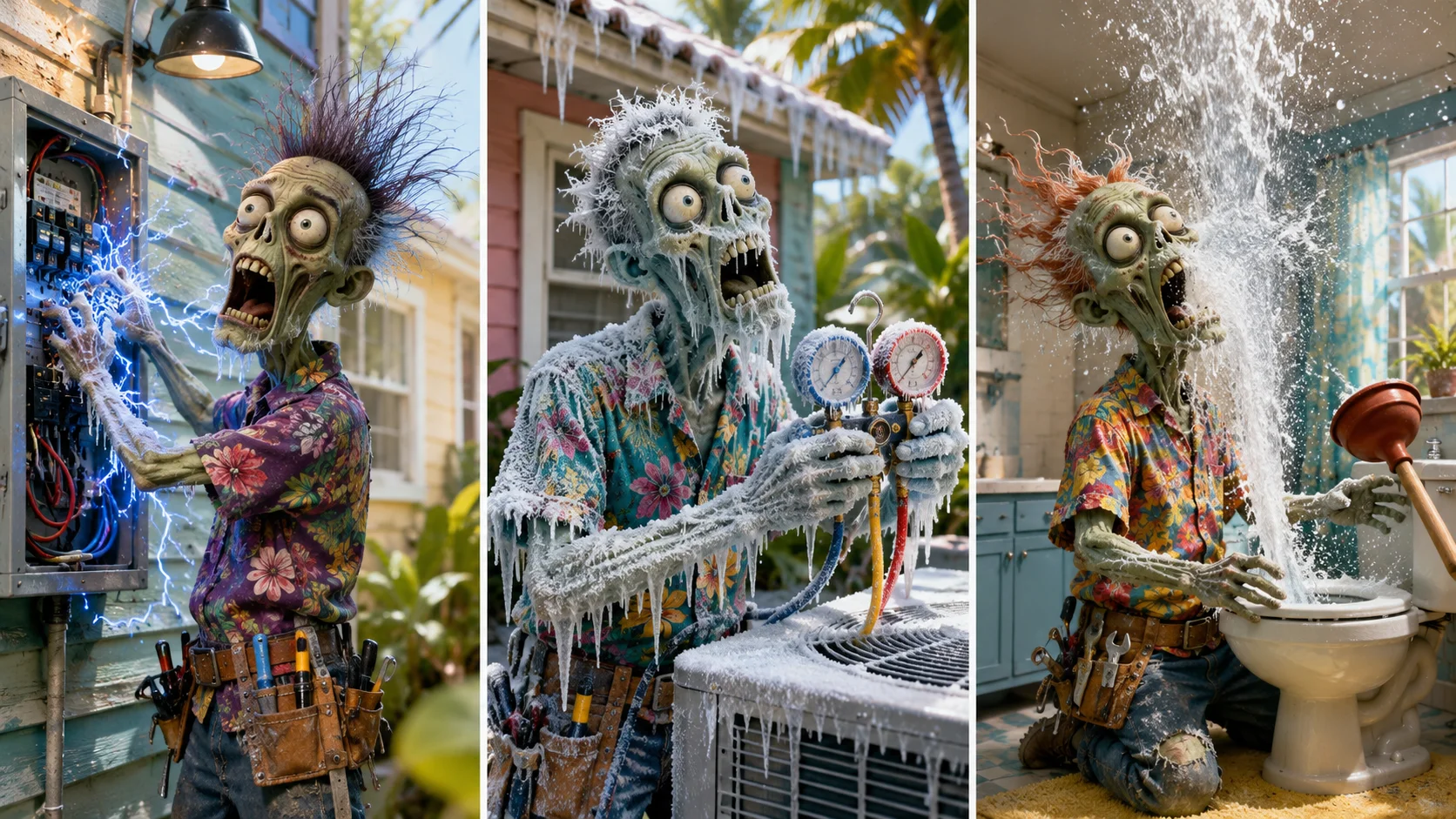
Three Ad Zombies zombie tradesmen having a very bad day — an electrician getting shocked at an open breaker panel, an air conditioning tech frozen solid in icicles at a condenser unit, and a plumber taking a geyser of water in the face from a toilet
Garage Door Website Design

Nobody Locked Out Of Their Garage Has Time For A Slow Website.

When a spring snaps or a door won’t budge, they’re not calmly comparing five companies. They’re searching, stuck, and clicking whoever loads first and looks like they’ll actually show up. If that site is slow, that customer just became your competitor’s.

Ad Zombies builds websites specifically for garage door companies — built to survive the exact moment they matter most: a broken spring or a stuck door when the customer just needs someone to answer.

Ad Zombies is a branding, advertising, and marketing company founded by Ken “Spanky” Moskowitz — 40 years in advertising, 10 Super Bowl ads, $460 billion in client revenue generated across a career that includes Coca-Cola, the NFL, and Frito-Lay. Web Reanimation is our website rebuild service, built for businesses that live and die by whether the phone rings today, not next quarter.

What We Build For Garage Door Companies

Separate content for spring repair, opener replacement, and full door installs — not one page pretending every job is the same
Load times fast enough to hold up when a cold snap or a bad storm sends a whole neighborhood searching at once
Same-day and emergency service made obvious above the fold for the homeowner locked in or out right now
Content built around your area’s actual codes and climate risk — wind/impact rating, coastal corrosion, or freeze effects on springs, whichever actually applies
Schema markup that helps Google — and AI search — surface you for repair intent and installation intent, not just whichever one you happened to write more about
Full ownership: the code, the content, the domain, all of it, yours

Most contractor websites are built by agencies that use the same site for every trade and just swap the logo. We build from your actual brand, your actual systems and brands you install, and your actual service area.

How Much Does A Website Cost For A Garage Door Company?

That’s one of the first things every owner wants to know, and we’re not going to dodge it. Web Reanimation projects start at $10,000. Final investment depends on how many service areas and pages you need, how much content we’re building, and whether you want an integrated quote-request tool or AI chat. You get a fixed-price proposal after a free assessment — not a vague “it depends” and a follow-up call three weeks later.

How Long Does It Take?

Most Web Reanimation projects take 6 to 12 weeks from kickoff to launch. We accept a maximum of 5 Web Reanimation projects per month across every industry we work with — so timelines are real, not padded to make room for everyone who calls.

What Happens After You Reach Out

1.Take the free Reanimation Assessment — 3 minutes, tells you exactly where your site is losing you business.
2.Get a fixed-price proposal scoped to your trade and service area.
3.We build: full audit, new architecture, all new copy, CMS setup, redirects, schema markup.
4.Launch, plus a 90-day check-in to make sure it’s actually performing.

Garage Door Website Design By Market

Garage door demand isn’t the same business everywhere — coastal wind-load codes and freeze risk change what actually sells. Pages built around specific markets:

Phoenix, AZ — The failure driver here is thermal cycling, not wind or cold -- and it shortens hardware life by roughly a third. Miami, FL — This is a High-Velocity Hurricane Zone, so a garage door is a code-regulated structural component, not a cosmetic choice -- and replacement can trigger a mandatory upgrade. Dallas–Fort Worth, TX — DFW is the most active hail belt in the country, which makes this an insurance-claim business as much as a repair business. Houston, TX — Wind-rating requirements here depend on which side of a highway the house sits on -- an unusually concrete local qualifying question. Atlanta, GA — Persistent year-round humidity, not storms or heat cycling, is what shortens hardware life in Atlanta garages. Los Angeles, CA — In LA the garage door is a fire-safety component with a required test standard -- and in much of the metro it is also being converted out of existence. Chicago, IL — Chicago's signature detached alley garage takes the full winter beating -- brittle springs, salted hardware, and a door frozen to its own slab. Tampa, FL — Tampa is wind-rated but it is not Miami -- different region, different approval paperwork, and getting that wrong is a failed inspection. Orlando, FL — Orlando still has a wind code, just a quieter one than the coasts -- and the paperwork that satisfies Miami does not automatically apply here. Charlotte, NC — Charlotte's boom filled the suburbs with builder-grade doors chosen on price, and the region's humidity is now collecting on that decision. Austin, TX — Austin is hail country, and the garage door is one of the largest impact surfaces on the house -- and one of the most commonly missed on a claim. Denver, CO — Denver sits squarely in 'Hail Alley' along the I-25 corridor, one of the most hail-battered stretches of the country, and garage doors take a regular beating alongside roofs. Washington, DC — DC's rowhouse-dominated core means a large share of homes have no garage at all — those that do are typically single alley-facing doors — while the city's real winter freeze cycle and heavy DDOT road-salt use create genuine spring-corrosion and cold-weather spring-tension issues. Philadelphia, PA — Philadelphia isn't a coastal/hurricane-code market — the distinctive angle here is the opposite: a huge share of the city's classic rowhouse stock was built before cars existed and has no garage at all. Detroit, MI — Detroit's garage door market is shaped almost entirely by cold-weather spring failure rather than wind/hurricane code or coastal corrosion. Seattle, WA — Seattle isn't a hurricane-code market, but its near-constant rain and humidity corrode garage door hardware and torsion springs faster than in drier climates, and steady new-home construction keeps first-install demand strong. San Diego, CA — Coastal salt air is the dominant local stressor on garage door hardware in San Diego, accelerating spring and opener corrosion in beach-adjacent neighborhoods, while the region's near-total absence of freezing temperatures removes cold-weather spring failure as a factor. Riverside, CA — Riverside County's terrain runs from urban valley to open desert, and its Santa Ana wind exposure plus a still-active new-home construction pipeline keep both wind-rated and new-install garage door work steady. Baltimore, MD — Baltimore's classic rowhouse stock was largely built without garages at all, so garage door demand skews heavily toward the county's suburban new-construction and detached-garage retrofits. Sacramento, CA — Sacramento isn't a coastal/hurricane-code market, but its exurban counties are among the fastest-growing in the state, meaning heavy new-construction garage door demand alongside extreme-heat service issues on older doors. Nashville, TN — Nashville isn't a coastal wind-code market, but it has real, verified severe-weather exposure — including a 2020 derecho that hit the metro with 60-80 mph straight-line winds — layered on top of a still-fast-growing new-construction pipeline. Raleigh, NC — Raleigh sits in the Piedmont, where the coastal plain meets the hills — inland enough to be outside NC's hurricane wind-load code territory, but squarely inside one of the fastest new-home-construction markets in the country. Columbus, OH — Columbus has no hurricane or coastal wind code to build around — the real local factor is a genuine freeze season that stiffens torsion springs, in a metro that's also building new homes fast. Indianapolis, IN — Indianapolis is inland, so there's no hurricane wind-load code or coastal salt corrosion to sell against — the real local angle is winter cold snaps stressing springs and openers, plus steady new-construction demand. Kansas City, MO — Kansas City sits in a recurring severe-hail corridor while cold winter snaps add torsion-spring stress that coastal, hurricane-code markets simply don't have. Jacksonville, FL — Jacksonville sits outside Florida's High-Velocity Hurricane Zone (Miami-Dade and Broward only) but is still fully subject to Florida Building Code wind-load and, in coastal/high-wind areas, wind-borne-debris rules. Oklahoma City, OK — Oklahoma City sits in what's colloquially called Tornado Alley and ranks among the top hail-prone states in the country, so garage doors here take a structural beating most of the country's don't. Cleveland, OH — Cleveland's garage door market runs almost entirely on replacement and repair rather than new installs — new-construction permits are scarce, and the metro's cold winters put extra stress on torsion springs. New Orleans, LA — Orleans Parish is designed to a 150-160 mph ultimate wind speed under the post-Katrina Louisiana State Uniform Construction Code, placing it in the wind-borne-debris region where garage doors need impact-rated glazing or shutter protection. Richmond, VA — Richmond sits about 100 miles inland from the Atlantic, so garage door work here is governed by real but moderate wind-load code rather than coastal hurricane/salt-corrosion conditions.

Work in a different trade? See website design for home service businesses for air conditioning, plumbing, and electrical.

Frequently Asked Questions

Web Reanimation projects start at $10,000. Final investment depends on how many service pages and service areas you need, how much content we’re building, and whether you want an integrated quote-request tool or AI chat. You get a fixed-price proposal after a free assessment — not a vague estimate and a follow-up call three weeks later.

That’s exactly what it’s built for. A broken spring or a door stuck shut means someone locked in or out searching on their phone right now. Web Reanimation sites load in under a second and put same-day and emergency service where that visitor can actually find it.

You own everything. The code, the content, the domain, and access to your CMS. No monthly "hostage fees," no platform lock-in. If you want ongoing support after launch, that’s optional — Managed Hosting starts at $197/month — but it’s never required to keep your own site running.

Yes — that’s exactly what a Web Reanimation build for a garage door company usually includes. If you install and repair across six cities, you need pages that actually target each one, not a single "service areas" page with a list of towns at the bottom.

Platforms like ServiceTitan or Housecall Pro bundle a basic site with their software, but you’re usually renting a template, not owning a real website — and it’s built to be good enough, not to actually rank or convert. Web Reanimation is a from-scratch build on its own stack, made to perform, that you keep even if you switch field service software later.

Ready to see what a real proposal looks like?

The assessment is free, takes three minutes, and won’t ask for a credit card.