
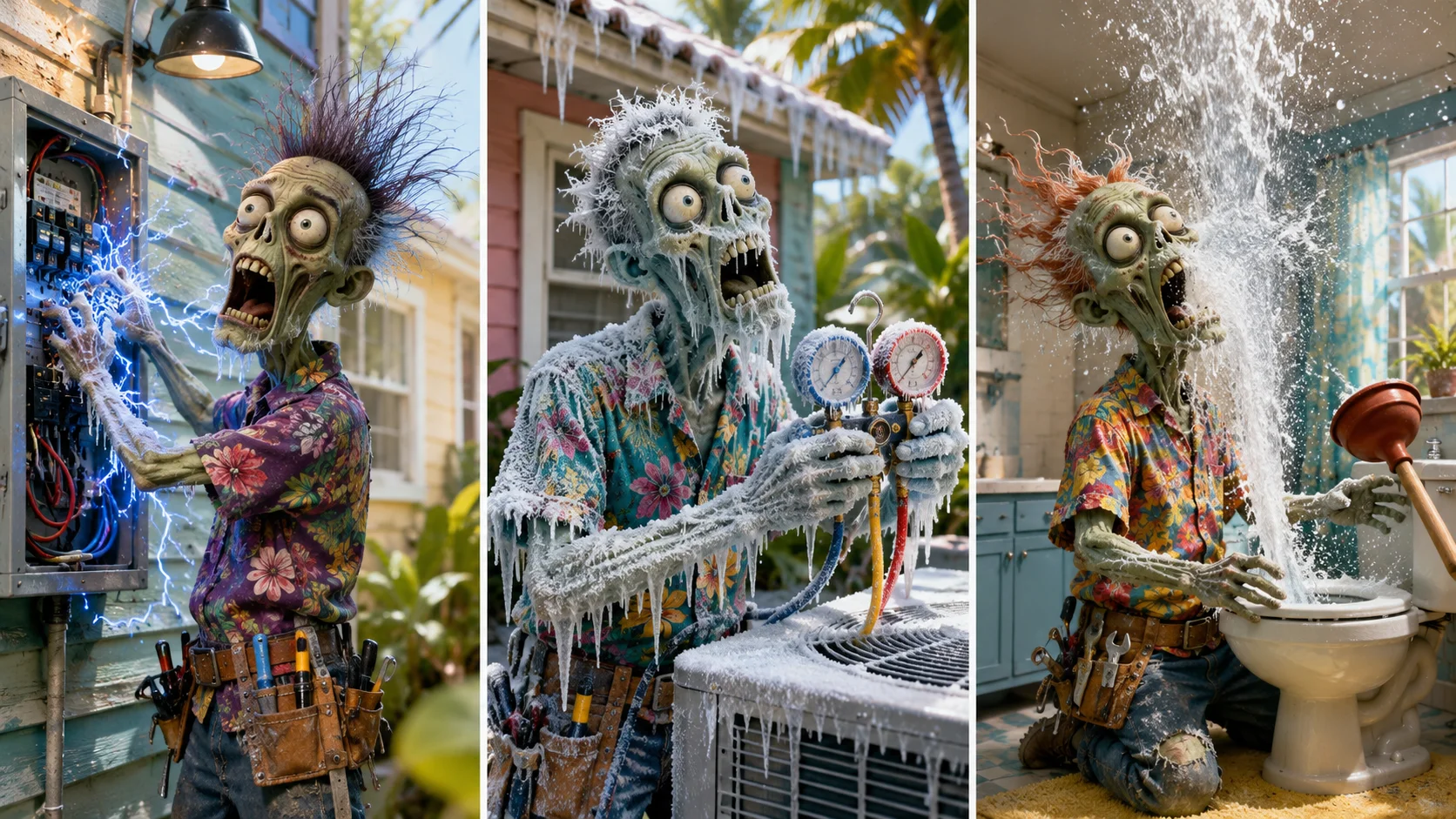
Three Ad Zombies zombie tradesmen having a very bad day — an electrician getting shocked at an open breaker panel, an air conditioning tech frozen solid in icicles at a condenser unit, and a plumber taking a geyser of water in the face from a toilet
Electrical Website Design

Nobody Googling “Electrician Near Me” Has Time For A Slow Site.

When someone’s panel trips or their power’s out, they’re not calmly comparing five electricians. They’re searching, frustrated, and clicking whoever loads first and looks like they’ll actually show up. If that site is slow, that customer just became your competitor’s.

Ad Zombies builds websites specifically for electrical companies — built to survive the exact moment they matter most: a panel failure or outage when the customer just needs someone to answer.

Ad Zombies is a branding, advertising, and marketing company founded by Ken “Spanky” Moskowitz — 40 years in advertising, 10 Super Bowl ads, $460 billion in client revenue generated across a career that includes Coca-Cola, the NFL, and Frito-Lay. Web Reanimation is our website rebuild service, built for businesses that live and die by whether the phone rings today, not next quarter.

What We Build For Electrical Companies

Separate content for panel upgrades, EV charger installs, and solar/storage interconnection — not one page pretending every job is a light-switch swap
Load times fast enough to hold up when an outage sends a whole neighborhood searching at once
Emergency service made obvious above the fold for the homeowner standing in the dark right now
Content built around your area’s actual housing stock and panel-era mix, not a generic "we do wiring" page
Schema markup that helps Google — and AI search — surface you for repair intent and installation intent, not just whichever one you happened to write more about
Full ownership: the code, the content, the domain, all of it, yours

Most contractor websites are built by agencies that use the same site for every trade and just swap the logo. We build from your actual brand, your actual systems and brands you install, and your actual service area.

How Much Does A Website Cost For An Electrical Company?

That’s one of the first things every owner wants to know, and we’re not going to dodge it. Web Reanimation projects start at $10,000. Final investment depends on how many service areas and pages you need, how much content we’re building, and whether you want an integrated quote-request tool or AI chat. You get a fixed-price proposal after a free assessment — not a vague “it depends” and a follow-up call three weeks later.

How Long Does It Take?

Most Web Reanimation projects take 6 to 12 weeks from kickoff to launch. We accept a maximum of 5 Web Reanimation projects per month across every industry we work with — so timelines are real, not padded to make room for everyone who calls.

What Happens After You Reach Out

1.Take the free Reanimation Assessment — 3 minutes, tells you exactly where your site is losing you business.
2.Get a fixed-price proposal scoped to your trade and service area.
3.We build: full audit, new architecture, all new copy, CMS setup, redirects, schema markup.
4.Launch, plus a 90-day check-in to make sure it’s actually performing.

Electrical Website Design By Market

Electrical demand isn’t the same business everywhere — housing age, panel-era mix, and EV/solar adoption change what actually sells. Pages built around specific markets:

Phoenix, AZ — A 1980s-median housing stock combined with electric-dominant heating and heavy cooling load means panel capacity is a recurring, sellable problem. Miami, FL — Miami-Dade is one of the only markets in the country where an inspection is legally scheduled onto the calendar -- the 40-year recertification turns aging electrical into mandatory, deadline-driven work. Dallas–Fort Worth, TX — Winter Storm Uri turned backup power from a luxury item into a mainstream conversation in this market, and that demand did not go away. Atlanta, GA — Atlanta does not have one wiring problem, it has three -- and which one a homeowner has is determined almost entirely by which neighborhood they bought in. Los Angeles, CA — In LA the panel is the bottleneck for everything -- EV charging, heat pumps, and the ADU in the backyard all land on the same undersized service. Chicago, IL — Chicago has its own electrical code, and it bans the wiring method used in almost every other American city. That single fact disqualifies most generic electrical content. Tampa, FL — In Tampa the electrical panel is an insurance problem before it is a capacity problem -- and the homeowner usually finds out at renewal, with a deadline attached. Orlando, FL — Orlando sits in Lightning Alley. Surge protection here is not an upsell, it is a defensible, data-backed core service. Charlotte, NC — North Carolina is one of the few states that licenses electricians by the dollar value of the job -- which quietly determines who can even bid your project. Denver, CO — A metro where half the housing stock predates 1987 is now retrofitting for EVs and solar at the fastest adoption rate in the country, putting real pressure on older panels. Washington, DC — DC's housing stock skews old — nearly a third built before 1940 — which means older panel infrastructure is common, while the city is simultaneously seeing the fastest EV-adoption curve in the country, driving demand for panel upgrades and EV-charger circuits. Philadelphia, PA — With a median home age near 1949 and a huge rowhouse stock built well before modern electrical demand, Philadelphia has an unusually large base of homes still running on legacy 60-amp service or older knob-and-tube wiring. Detroit, MI — With roughly 85% of Detroit's housing built before 1970, a large share of homes still carry undersized fuse boxes or knob-and-tube-era wiring that can't support modern loads. Seattle, WA — With a median build year around 1985 and nearly 10% of homes built before 1940, Seattle has a large stock of houses still running on original 60-amp or 100-amp panels and, in the oldest neighborhoods, literal knob-and-tube wiring. Minneapolis, MN — With a median Minneapolis home built in 1951 and roughly 43% of homes built before 1940, a large share of the housing stock predates modern panel capacity and grounding standards. San Diego, CA — A housing stock where most homes were built decades before today's EV-and-solar electrical loads intersects with one of the highest residential solar adoption rates in the country. Riverside, CA — With a citywide median construction year of 1976, a large share of Riverside's housing stock predates modern electrical demand — old panel technology colliding with today's EV chargers, solar, and induction ranges. Baltimore, MD — With a median home age near 75 years and rowhouses built well before modern electrical code, Baltimore has a large base of homes that started life on knob-and-tube wiring and fuse boxes rather than modern breaker panels. St. Louis, MO — A metro with genuinely old core housing stock — pre-1940 neighborhoods with surviving knob-and-tube wiring and 1950s-80s homes still running on failure-prone Federal Pacific or Zinsco panels. Sacramento, CA — A housing stock with a 1977 median build year means a lot of Sacramento panels were sized for a pre-EV, pre-solar household, right as Title 24 pushes new construction toward solar-and-EV-ready electrical. Portland, OR — Oregon posted a 20.7% EV registration share in Q3 2025 -- the 4th-highest in the US -- putting real load-capacity pressure on a housing stock still heavily reliant on gas heat. Nashville, TN — Nashville's housing stock skews mid-century-to-1980s, and Tennessee runs unusually electric-heavy on home heating — a combination that puts real load on older panels just as EV ownership climbs statewide. Raleigh, NC — A young housing stock (median build year 1997) means most Raleigh homes are on modern 100-200A panel-era wiring, but the region's fast-growing EV adoption is now pushing even those newer panels toward capacity upgrades. Columbus, OH — A housing stock with a median build year of 1982 combined with over a third of homes already heating on electricity means panel capacity is a live issue across Columbus. Indianapolis, IN — With a median build year of 1973 and a third of the housing stock older than 1960, a real share of Indianapolis panels predate modern load demands — and electrical licensing here is a city call, not a state one. Kansas City, MO — KC's housing stock skews old — over a fifth of homes predate 1940 and the median home is 53 years old — putting a large share of the market on legacy panels and wiring. Jacksonville, FL — Jacksonville's electric utility, JEA, is actively building out EV charging infrastructure and has run PEV purchase rebates, signaling panel-upgrade demand on top of an electric-heat-dominant housing stock. Oklahoma City, OK — With the median Oklahoma City home dating to 1982, a lot of the metro's electrical panels predate the load they're now being asked to carry — and Oklahoma just posted the fastest EV-registration growth of any state. Salt Lake City, UT — Utah runs on natural gas more than any other state, so electrical panels here carry a lighter heating load than electric-heat-dominant markets -- but EV and solar interconnection is climbing fast. Cincinnati, OH — With a metro-wide median year-built of 1971 (urban core skewing to 1962 or earlier), a large share of Cincinnati-area housing predates modern code-driven electrical capacity. Cleveland, OH — Cleveland's electrical trade is shaped by its old housing stock — half the city's homes predate 1940, meaning outdated panels and legacy wiring are common. Pittsburgh, PA — 46.6% of Pittsburgh's housing units were built in 1939 or earlier — one of the oldest housing stocks of any major metro — meaning a large share of homes still run original or early-replacement electrical service. Milwaukee, WI — Milwaukee's housing stock is old — about three-quarters of homes predate 1970 — which means a large share of local panels and wiring are well past their original design life. Memphis, TN — The median Memphis home was built in 1970 -- squarely inside the era of 60-100A fuse panels and aluminum branch wiring, not the 200A copper standard. New Orleans, LA — With a median home built in 1960 and roughly a third of the housing stock from before 1940, a large share of Orleans Parish homes were originally wired for far less electrical load than modern households demand. Richmond, VA — Richmond's housing stock skews old — 28% pre-1939, another third from the 1940s-60s — which means a lot of homes are still running panels and service sizes designed for a pre-air-conditioning, pre-EV electrical load.

Work in a different trade? See website design for home service businesses for air conditioning, plumbing, and garage door.

Frequently Asked Questions

Web Reanimation projects start at $10,000. Final investment depends on how many service pages and service areas you need, how much content we’re building, and whether you want an integrated quote-request tool or AI chat. You get a fixed-price proposal after a free assessment — not a vague estimate and a follow-up call three weeks later.

That’s exactly what it’s built for. Electrical emergencies mean someone with no power is searching on their phone, frustrated, right now. Web Reanimation sites load in under a second and put emergency service where that visitor can actually find it.

You own everything. The code, the content, the domain, and access to your CMS. No monthly "hostage fees," no platform lock-in. If you want ongoing support after launch, that’s optional — Managed Hosting starts at $197/month — but it’s never required to keep your own site running.

Yes — that’s exactly what a Web Reanimation build for an electrical company usually includes. If you install and repair across six cities, you need pages that actually target each one, not a single "service areas" page with a list of towns at the bottom.

Platforms like ServiceTitan or Housecall Pro bundle a basic site with their software, but you’re usually renting a template, not owning a real website — and it’s built to be good enough, not to actually rank or convert. Web Reanimation is a from-scratch build on its own stack, made to perform, that you keep even if you switch field service software later.

Ready to see what a real proposal looks like?

The assessment is free, takes three minutes, and won’t ask for a credit card.