
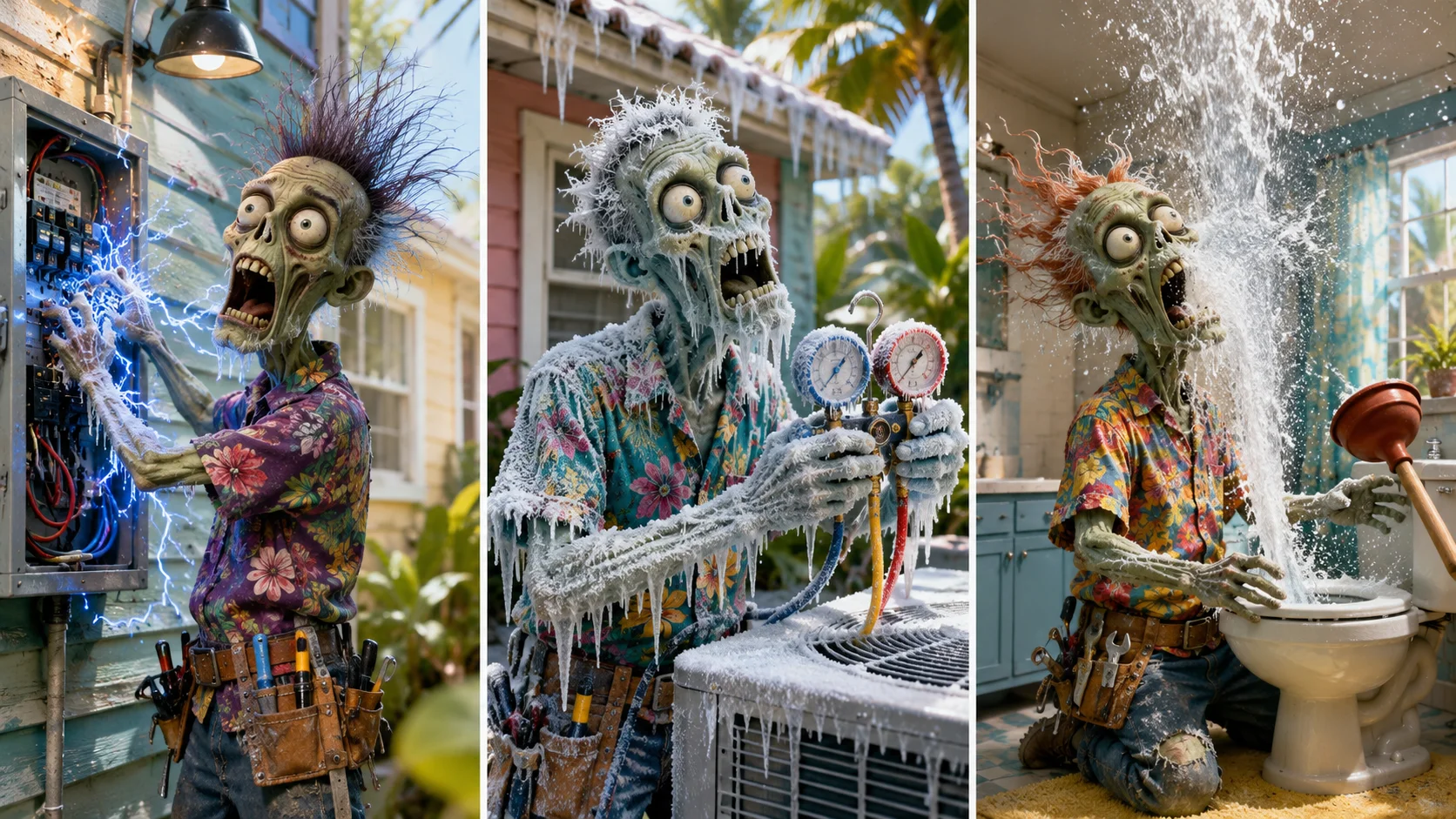
Three Ad Zombies zombie tradesmen having a very bad day — an electrician getting shocked at an open breaker panel, an air conditioning tech frozen solid in icicles at a condenser unit, and a plumber taking a geyser of water in the face from a toilet
Air Conditioning Website Design

Your Slow-Season Website Can’t Handle Your Busy-Season Traffic.

When someone’s AC dies in July, they’re not calmly comparing five contractors. They’re searching, panicking, and clicking whoever loads first and looks like they’ll actually show up. If that site is slow, that customer just became your competitor’s.

Ad Zombies builds websites specifically for air conditioning and cooling companies — built to survive the exact moment they matter most: a hundred-degree day when everyone in your service area is searching for the same thing at once.

Ad Zombies is a branding, advertising, and marketing company founded by Ken “Spanky” Moskowitz — 40 years in advertising, 10 Super Bowl ads, $460 billion in client revenue generated across a career that includes Coca-Cola, the NFL, and Frito-Lay. Web Reanimation is our website rebuild service, built for businesses that live and die by whether the phone rings today, not next quarter.

What We Build For Air Conditioning Companies

Pages built to rank for "AC repair," "AC replacement," and "air conditioning installation" searches in your market — not just one of the three
Load times fast enough to survive a heat-wave traffic spike without slowing down at the exact wrong moment
Emergency and same-day service made obvious above the fold, not buried under a paragraph of company history
Financing and system-comparison content that helps homeowners justify a big-ticket replacement decision
Schema markup that helps Google — and AI search — surface you for repair intent and installation intent, not just whichever one you happened to write more about
Full ownership: the code, the content, the domain, all of it, yours

Most contractor websites are built by agencies that use the same site for every trade and just swap the logo. We build from your actual brand, your actual systems and brands you install, and your actual service area.

How Much Does A Website Cost For An Air Conditioning Company?

That’s one of the first things every owner wants to know, and we’re not going to dodge it. Web Reanimation projects start at $10,000. Final investment depends on how many service areas and pages you need, how much content we’re building, and whether you want an integrated quote-request tool or AI chat. You get a fixed-price proposal after a free assessment — not a vague “it depends” and a follow-up call three weeks later.

How Long Does It Take?

Most Web Reanimation projects take 6 to 12 weeks from kickoff to launch. If your busy season is coming up, that’s exactly the kind of timeline you should be planning around now, not in June. We accept a maximum of 5 Web Reanimation projects per month across every industry we work with — so timelines are real, not padded to make room for everyone who calls.

What Happens After You Reach Out

1.Take the free Reanimation Assessment — 3 minutes, tells you exactly where your site is losing you business.
2.Get a fixed-price proposal scoped to your trade and service area.
3.We build: full audit, new architecture, all new copy, CMS setup, redirects, schema markup.
4.Launch, plus a 90-day check-in to make sure it’s actually performing.

Can You Build A Page That Actually Highlights Emergency, Same-Day Service?

Yes — and it should be one of the first things a visitor sees, not something they have to scroll to find. If same-day or emergency service is part of what you offer, it gets built into the page structure itself, not added as an afterthought.

Air Conditioning Website Design By Market

Cooling demand isn’t the same business everywhere — a market with a short, compressed season and a lot of un-ducted housing stock sells nothing like a near-year-round one. Pages built around specific markets:

Phoenix, AZ — Cooling here is not a comfort upgrade, it is life safety, and the equipment runs so many hours a year that replacement cycles arrive faster than in almost any other market. Miami, FL — Salt air eats equipment roughly three times faster here, which turns replacement cycles from a 15-year conversation into a 5-to-7-year one. Dallas–Fort Worth, TX — Equipment here has to survive both a long punishing cooling season and hard freeze events -- a dual requirement most markets do not impose. Houston, TX — The counterintuitive local truth worth an entire page: an oversized air conditioner makes a Houston house MORE humid and more mold-prone, not less. Atlanta, GA — In Atlanta the enemy is humidity, not heat -- and a system sized only for temperature will leave a house cold, clammy and still uncomfortable. Los Angeles, CA — Two regulatory changes and one deadly heatwave have turned LA from a market that could ignore cooling into one where cooling is being mandated -- and heat pumps are now the default, not the upsell. Chicago, IL — Chicago's cooling market is not a replacement market like Phoenix -- for a large share of the housing stock it is still a first-installation market, because the house was never ducted at all. Tampa, FL — Tampa equipment fails for a reason most markets never deal with: salt. Chloride corrosion runs on the calendar, not on the run-hour meter. Orlando, FL — Orlando has a housing category almost no other market does: thousands of purpose-built vacation rental pool homes where an AC failure is a refund, not a discomfort. Charlotte, NC — In Charlotte the ductwork lives in a humid, vented crawl space under the house -- so the HVAC problem and the moisture problem are the same problem. Las Vegas, NV — Las Vegas is dry enough that swamp coolers genuinely work -- and humid enough for two months a year that they genuinely don't. Managing that switchover is a service business Phoenix doesn't have. San Antonio, TX — In San Antonio the utility is city-owned, which means the rebate that changes a homeowner's mind is local, specific, and something a good contractor can quote from memory. Austin, TX — Austin publishes a numeric efficiency threshold new homes have to hit. That turns 'high efficiency' from a sales adjective into a pass/fail number. Denver, CO — Denver's mile-high elevation means furnaces don't perform like their sea-level ratings — combustion air here has roughly 17% less oxygen, so equipment needs code-mandated altitude derating to actually heat a home right. Washington, DC — DC runs a genuine two-season HVAC market — hot, humid summers (July/August highs near 90°F with RH in the 70s) paired with winters cold enough for hard freezes — and a huge share of the housing stock predates central ducting entirely. Philadelphia, PA — Philadelphia's cooling season is long and muggy (average humidity 67%, peaking near 77% in October) layered on top of a real winter (Jan averages 26°F lows, ~18 in. of snow/year) — HVAC systems here have to handle both a genuine heating load and a genuine humidity load. Detroit, MI — Detroit's brutal seasonal swing — 83°F July days to 18°F January nights — means furnaces and AC systems both get pushed to their limits, and central air is still far from universal in the city's older housing stock. Seattle, WA — Seattle went from the least air-conditioned big city in America to an AC town in barely a decade — 53% of homes had some form of air conditioning in 2021, up from 44% in 2019 and just 31% in 2013, and most of that cooling is still window/portable units rather than central air. Minneapolis, MN — Minneapolis furnaces work a genuinely long, hard winter while central air covers a shorter, humid summer window — a heating-dominant climate that ages equipment differently than a mild-winter market. San Diego, CA — San Diego's mild coastal climate has historically meant far lower central-AC penetration than the rest of the country, but rising heat waves are pushing installs even as freeze/heating-strip failure is a non-issue here. Riverside, CA — Riverside's cooling season is long and severe — ASHRAE design temperatures for Manual J load calcs in Riverside are 35°F (99% winter) and 99°F (1% summer), and the city has hit 118°F in July 2018. Baltimore, MD — Baltimore's climate swings from 27°F winter lows to 85°F+ humid summer highs, and the city's rowhouse-dominated, pre-1950s housing stock was never built with central ductwork in mind — so HVAC work here is disproportionately retrofit and mini-split/ductless conversion. St. Louis, MO — St. Louis's combination of hot, humid summers and genuinely cold winters means systems have to perform at both extremes, and the metro already has unusually high central-air penetration. Sacramento, CA — Sacramento summers are long, hot, and dry — average June-August highs run 88.7-94.6°F with roughly 23 days a year hitting 100°F — so AC capacity and run-time reliability matter far more here than heating. Portland, OR — Portland's mild, short cooling season historically kept AC out of most homes -- only about three-quarters of Portland-metro households have any air conditioning at all, well below the 91% national average -- but recent heat waves have driven a fast retrofit push. Nashville, TN — Nashville's humid subtropical climate means a long, muggy cooling season stacked on top of real winter cold snaps — systems here run hard nearly year-round. Raleigh, NC — Raleigh's humid subtropical climate means AC isn't seasonal backup — it's a long-season, high-humidity load that runs hard from May through September, on top of winter lows that still regularly hit the low-30s. Columbus, OH — Columbus runs a full four-season climate — hot, humid summers and cold winters that push both AC and furnace/heat pump systems hard in the same year. Indianapolis, IN — Indianapolis systems get worked in both directions every year: real winter freeze risk down into the negative teens some winters, followed by hot, humid summers with dew points near 65°F. Kansas City, MO — KC's climate straddles humid continental and humid subtropical zones, meaning systems have to handle both a real winter freeze season and a muggy, 90°F+ summer stretch. Jacksonville, FL — Jacksonville's cooling season runs nearly year-round with only about 4 freezing days annually, so HVAC demand is overwhelmingly AC-driven rather than seasonal-swing furnace work. Oklahoma City, OK — OKC's hot, humid summers push air conditioning into near-daily use for months at a stretch, while a rare but brutal deep freeze can knock a heating system out just as fast. Salt Lake City, UT — Salt Lake City runs two demanding seasons back to back -- hot dry summers and cold winters -- and every winter the valley's temperature inversions turn HVAC filtration into an air-quality issue, not just a comfort one. Cincinnati, OH — Cincinnati's climate forces HVAC systems to work both ends of the calendar — muggy, 90-degree summer stretches and winters that regularly flirt with single digits. Cleveland, OH — Cleveland runs a long, sharply divided HVAC season — cold, lake-effect winters push heating demand hard while summers stay short but humid, and half the housing stock predates central air as a standard feature. Pittsburgh, PA — Pittsburgh runs a real four-season HVAC market: 124-plus sub-freezing nights a year push furnace load hard, while humid summers keep AC and dehumidification demand genuine. Milwaukee, WI — Milwaukee's cooling season is short and its winters are furnace-dominant — most homes here run on natural gas heat — while a surprising number of local households still have no air conditioning at all. Memphis, TN — Memphis's cooling season is long and humid, but the city also takes real hard freezes -- most recently in January 2026 -- so the honest local HVAC story is a system that has to handle both extremes. New Orleans, LA — New Orleans runs a near year-round cooling season, with 77 days a year of 90°F+ highs — systems here work overtime on both temperature and moisture removal, while true freeze risk is minor. Richmond, VA — Richmond's humid subtropical climate means summer cooling load is driven as much by 70% average humidity as by heat, while a real (if moderate) winter freeze risk keeps heat pumps and furnaces both in play.

Work in a different trade? See website design for home service businesses for plumbing, electrical, and garage door.

Frequently Asked Questions

Web Reanimation projects start at $10,000. Final investment depends on how many service pages and service areas you need, how much content we’re building, and whether you want an integrated quote-request tool or AI chat. You get a fixed-price proposal after a free assessment — not a vague estimate and a follow-up call three weeks later.

That’s exactly what it’s built for. Most contractor sites run on bloated platforms that slow down or choke under real load — the worst possible moment for an AC company, since that’s precisely when everyone is searching at once. Web Reanimation sites load in under a second and are built on infrastructure meant to handle spikes, not just steady traffic.

You own everything. The code, the content, the domain, and access to your CMS. No monthly "hostage fees," no platform lock-in. If you want ongoing support after launch, that’s optional — Managed Hosting starts at $197/month — but it’s never required to keep your own site running.

Yes — that’s exactly what a Web Reanimation build for an air conditioning company usually includes. If you install and repair across six cities, you need pages that actually target each one, not a single "service areas" page with a list of towns at the bottom.

Platforms like ServiceTitan or Housecall Pro bundle a basic site with their software, but you’re usually renting a template, not owning a real website — and it’s built to be good enough, not to actually rank or convert. Web Reanimation is a from-scratch build on its own stack, made to perform, that you keep even if you switch field service software later.

Ready before your next heat wave?

The assessment is free, takes three minutes, and won’t ask for a credit card.