
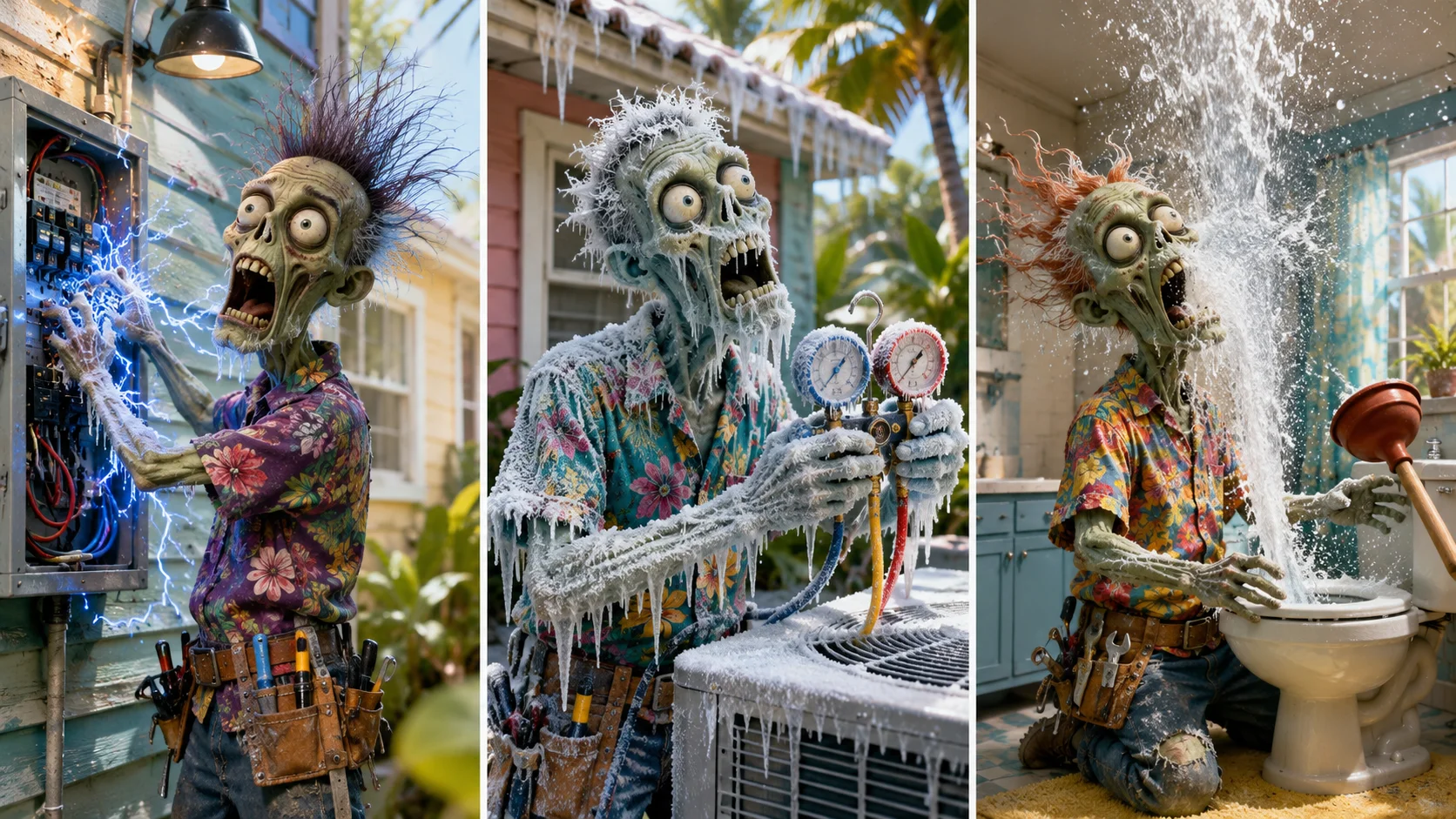
Three Ad Zombies zombie tradesmen having a very bad day — an electrician getting shocked at an open breaker panel, an air conditioning tech frozen solid in icicles at a condenser unit, and a plumber taking a geyser of water in the face from a toilet
Air Conditioning Website Design · Washington, DC

Air Conditioning Website Design For Washington, District of Columbia

DC runs a genuine two-season HVAC market — hot, humid summers (July/August highs near 90°F with RH in the 70s) paired with winters cold enough for hard freezes — and a huge share of the housing stock predates central ducting entirely.

You’ve probably seen the generic version of this page before — the one that says “serving Washington and the surrounding area” a dozen times and calls it local. That’s not what this is. Ad Zombies builds websites for air conditioning companies built around how Washington’s market actually works, not a template with the city name dropped in.

Why Washington Is Different For Air Conditioning Companies

DC runs a genuine two-season HVAC market — hot, humid summers (July/August highs near 90°F with RH in the 70s) paired with winters cold enough for hard freezes — and a huge share of the housing stock predates central ducting entirely.

  • Köppen Cfa humid subtropical climate: hot, humid summers and cold winters, per climate-data sources.
  • July highs have reached 101°F; February lows have dropped to 4°F, giving equipment real load in both directions.
  • Summer relative humidity sits around 74-84% depending on month, which is a real latent-load (dehumidification) factor for AC sizing.
  • 31.5% of DC's housing stock was built before 1940 — much of it originally heated by steam or hot-water radiators, not ducted forced air, so ductless mini-split and retrofit ducting work is a distinct local HVAC segment.
  • DC's median home construction year is 1958, meaning a large share of the housing stock has been retrofitted at least once for central air rather than being built with it.

Licensing And Permits In District of Columbia

DC licenses electricians, plumbers, gas fitters, and HVAC/refrigeration mechanics through its own Board of Industrial Trades under the Department of Licensing and Consumer Protection (DLCP), separate from Maryland and Virginia's licensing regimes.

  • Master electrician applicants need 8 years/16,000 hours of experience before sitting the DC exam (80 multiple-choice questions, 4-hour limit).
  • Master plumber applicants must hold a valid journeyman plumber license and have worked as a journeyman for at least 4 years.
  • HVAC/refrigeration contractors need 5 years of experience verified by a licensed master mechanic before applying to test for Master Refrigeration and Air Conditioning Mechanic (or the Limited variant).
  • Gas pipe fitters are separately licensed (Journey, Master, and Contractor Gas Pipe Fitter) through DLCP.
  • Both the business entity and the individual master-level license holder must be bonded, and contractors need a DC business license plus liability insurance.

Homeowners search for this before they call, and getting it right on your own site is the difference between looking like the licensed operator you are and looking like every unvetted lead-gen page in the results.

The Washington Housing Stock You’re Actually Serving

DC's median home construction year is 1958, and about 31.5% of the housing stock was built before 1940 — nearly triple the roughly 13% pre-1940 share nationwide — reflecting the city's dense inventory of century-old rowhouses.

DC has a humid subtropical climate (Köppen Cfa) — hot, humid summers with highs near 90-101°F and relatively cold winters that regularly dip into the 20s and single digits, so HVAC systems face real seasonal duty in both directions.

Summer humidity runs high (70s-80s% RH even at its lowest in July/August) while winter lows are cold enough for hard freezes, giving DC both a strong AC season and a real heating season, unlike Deep South or Southwest metros with one-sided HVAC demand.

DC's older rowhouse core historically relied on steam/hot-water radiator heat rather than ducted forced air, a genuine local plumbing/HVAC distinction even without a verified citywide gas-vs-electric percentage.

What We Build For Washington Air Conditioning Companies

Separate content for central air, ductless mini-splits, and window units -- not one page that only covers whichever system is easiest to write about
Load times fast enough to hold up when the first real heat wave sends everyone searching at once
Emergency and same-day service made obvious immediately, not buried below a company history section
Financing and system-comparison content for homeowners deciding whether this is finally the year they upgrade
Full ownership: the code, the content, the domain, all of it, yours

Ad Zombies is a branding and marketing company founded by Ken “Spanky” Moskowitz — 40 years in advertising, 10 Super Bowl ads, $460 billion in client revenue generated. Web Reanimation is our website rebuild service: fast, fully owned, built for businesses whose busy season doesn’t wait.

How It Works

1.Take the free Reanimation Assessment — 3 minutes.
2.Get a fixed-price proposal scoped to your systems and service area.
3.We build: audit, architecture, copy, CMS setup, schema markup.
4.Launch.

Air Conditioning Website Design In Nearby Markets

Every market prices, permits, and sells differently. Other air conditioning markets we build for:

Want AI chat and automated booking built in? See AI integration for air conditioning companies in Washington. Not in Washington, or not in air conditioning? See air conditioning website design for how we build for the trade generally, website design for home service businesses for the other trades, or every industry we build for.

Frequently Asked Questions

Fair question — most "location pages" are exactly that. Ad Zombies works with businesses remotely, wherever they are, so we’re not claiming a Washington office we don’t have. What we do build is a site scoped around your actual service area and Washington’s actual market: DC runs a genuine two-season HVAC market — hot, humid summers (July/August highs near 90°F with RH in the 70s) paired with winters cold enough for hard freezes — and a huge share of the housing stock predates central ducting entirely.

The same as anywhere: Web Reanimation projects start at $10,000, scoped to your service area and systems. You get a fixed-price proposal after a free assessment, not a vague estimate.

You own everything — the code, the content, the domain, and access to your CMS. No monthly "hostage fees," no platform lock-in.

Most Web Reanimation projects take 6 to 12 weeks from kickoff to launch. We accept a maximum of 5 Web Reanimation projects per month across every industry we work with, so timelines are real, not padded to make room for everyone who calls.

Ready before next summer hits?

The assessment is free, takes three minutes, and won’t ask for a credit card.